Education
How Much Bankroll Do You Need to Start Sports Betting Seriously?
Thursday, 20 August 2026
When a bettor decides to take a more structured approach to sports betting, one question quickly comes up:
How much bankroll do you need to start betting seriously?
€500? €1,000? €5,000? €10,000?
It would be tempting to give a specific number. The reality, however, is more complex.
A €5,000 bankroll may be perfectly suitable for one strategy and insufficient for another. Conversely, a bankroll of only €1,000 can be managed seriously if stake sizes are properly calibrated.
The real question is therefore not:
“How much money do I need to start?”
But rather:
“How many betting units do I need to apply my strategy while keeping risk under control?”
In this second article in our sports betting bankroll management series, we will look at how to determine an appropriate starting bankroll.
There Is No Universal Minimum Bankroll
Let's begin with an essential point.
There is no minimum amount of money that suddenly makes someone a serious sports bettor.
You can manage a bankroll of:
€500
just as rigorously as a bankroll of:
€5,000
or:
€50,000
The amount available obviously determines how much money can be wagered and the potential profit or loss in monetary terms.
But bankroll size alone does not determine the quality of bankroll management.
What matters more is the relationship between:
Bankroll → Stake Size → Number of Units → Risk
A bettor with €1,000 who risks €10 per bet is working with 100 betting units.
Another bettor with €10,000 who risks €1,000 per bet effectively has only 10 betting units.
The second bettor has ten times more money.
Yet their approach to risk is considerably more aggressive.

Think in Betting Units Before Thinking in Money
This is probably the most important shift in perspective.
Instead of starting with the question:
“How much should I bet?”
it is better to begin by defining:
“What percentage of my bankroll will one unit represent?”
Let's return to the hypothetical bankroll we use throughout this series:
Bankroll: €5,000
If we decide that:
1U = 1% of the bankroll
then:
1U = €50
Our bankroll therefore contains:
100 units
Thinking this way separates risk management from the absolute amount of money being invested.
With a €1,000 bankroll:
1U = €10
With a €5,000 bankroll:
1U = €50
With a €10,000 bankroll:
1U = €100
In all three situations, if 1U represents 1%, the stake relative to the available capital is identical.
€500, €1,000, €5,000 or €10,000 Bankroll: What's the Difference?
Let's compare four different bankroll sizes using a fixed stake equal to 1% of the starting capital.
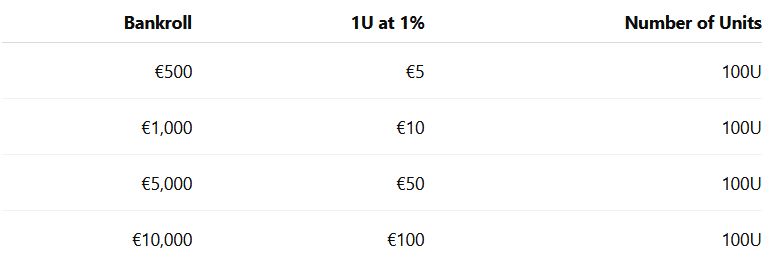
From a relative perspective, all four bettors are using the same bankroll structure.
The main difference is the amount of money actually being wagered and, consequently, the profits or losses expressed in euros.
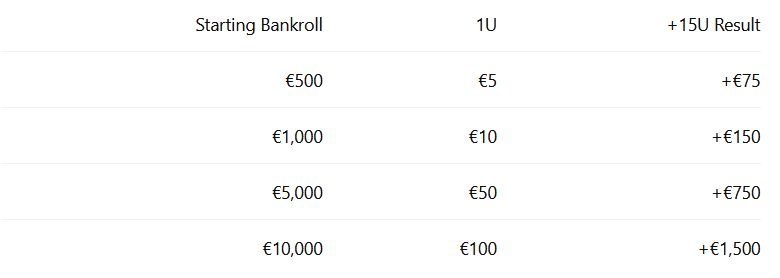
Suppose a strategy finishes a period at:
+15U
With a fixed unit size, this would represent:
From a relative perspective, all four bettors are using the same bankroll structure.
The main difference is the amount of money actually being wagered and, consequently, the profits or losses expressed in euros.
Suppose a strategy finishes a period at:
+15U
With a fixed unit size, this would represent:
Starting Bankroll1U+15U Result€500€5+€75€1,000€10+€150€5,000€50+€750€10,000€100+€1,500
In this simplified example, all four bettors have achieved the same relative performance:
+15% of their starting capital
But the monetary result is obviously different.
This is a fundamental distinction between performance and money earned.
Does a Small Bankroll Prevent You from Betting Seriously?
No.
A small bankroll does not prevent you from applying a serious methodology.
With €500, it is perfectly possible to:
- define a betting unit;
- use fixed stakes;
- measure ROI;
- track drawdown;
- analyse variance;
- maintain a complete betting record;
- evaluate a strategy over a large sample of bets.
However, a small bankroll creates an obvious limitation:
The monetary value of potential profits will remain limited.
Suppose a strategy produces a +5% return over a given period.
With €500, this represents:
+€25
With €5,000:
+€250
With €50,000:
+€2,500
The relative return is identical.
The monetary return clearly is not.
It is therefore important to distinguish between two objectives:
Learning to bet using a rigorous methodology
and
Generating financially significant results in absolute terms.
These are not exactly the same problem.
Why €5,000 Is a Useful Example
Throughout this series, we use a hypothetical bankroll of:
€5,000
This amount is not presented as a recommended minimum.
It is primarily useful because it allows us to work with simple examples.
With:
Bankroll = €5,000
and:
1U = 1%
we get:
1U = €50
The calculations then become particularly easy to understand.
A loss of:
-5U = -€250
A loss of:
-10U = -€500
A profit of:
+20U = +€1,000
A 20U drawdown, using a fixed €50 unit, represents:
-€1,000
or:
-20% of the starting bankroll
We will continue to use this reference throughout the following articles.
Bankroll Size Also Depends on the Strategy
This is where bankroll management becomes more interesting.
Two profitable betting strategies may require different levels of caution.
Why?
Because they may have:
- different win rates;
- different average odds;
- different betting volumes;
- different levels of variance;
- different historical drawdowns;
- bets that may sometimes be correlated.
A strategy that mainly bets at odds around 1.50 does not necessarily have the same variance profile as a strategy regularly betting at odds of 4.00 or 5.00.
Likewise, a strategy placing 30 bets per month does not have the same exposure pattern as one placing 500 bets per month.
The appropriate bankroll size cannot therefore be determined solely from an amount of money.
You also need to understand the statistical behaviour of the strategy.
Odds Affect Variance
Consider two theoretical strategies.
Strategy A
It mainly places bets at odds around:
1.50
Strategy B
It mainly places bets at odds around:
4.00
Even if both strategies have positive expected value, their sequences of results can look very different.
A strategy betting at higher odds will generally have a lower win rate and may therefore experience longer losing streaks.
This does not necessarily mean that the strategy is less profitable.
It does mean, however, that its bankroll needs to be able to withstand that variance.
This is why a rule such as:
“You always need 100 units.”
should be treated with caution.
One hundred units can be a useful starting framework, but it is not a universal guarantee of safety.
Betting Volume Matters Too
The number of bets placed also matters.
Consider two strategies.
Strategy A
50 bets per month
Strategy B
1,000 bets per month
With the same unit size, the second strategy turns over the bankroll much more quickly.
However, we should avoid jumping to the conclusion that more bets automatically mean more risk.
The actual risk also depends on:
- the strategy's genuine edge;
- the distribution of odds;
- stake size;
- correlation between bets;
- the number of positions open at the same time.
Betting volume should therefore be analysed together with the strategy's overall risk profile.
Don't Ignore Simultaneous Exposure
There is another dimension of bankroll management that is often overlooked.
Suppose our bettor has:
€5,000
with:
1U = €50
If they place one bet, the stake represents:
1% of the bankroll
But if they have 15 separate 1U bets open at the same time, the total capital committed is:
15 × €50 = €750
or:
15% of the bankroll
This does not mean that 15% of the bankroll will necessarily be lost.
It means that 15% of the bankroll is simultaneously exposed to outcomes that have not yet been determined.
This concept becomes particularly important when managing multiple strategies or following several tipsters.
The Real Challenge: Surviving Losing Streaks
Suppose we genuinely have a profitable strategy.
Even then, we may experience:
5 consecutive losses
10 consecutive losses
or potentially more, depending on the strategy's profile.
With our €5,000 bankroll and a fixed €50 unit:
5 losses = -€250
10 losses = -€500
20 losses = -€1,000
This represents respectively:
-5%
-10%
-20%
of the starting capital.
Now imagine instead that each bet represented 5% of the starting bankroll.
One unit would then be:
€250
Ten losses would represent:
-€2,500
or half of the starting capital.
This brings us back to a central principle:
The size of your bankroll will not protect you if your stakes are disproportionate.
Does a Larger Bankroll Mean Larger Profits?
In absolute terms, yes, assuming the same relative performance.
If a strategy genuinely produces +10% over a given period:
€500 → +€50
€5,000 → +€500
€50,000 → +€5,000
But there is an important limitation.
You cannot assume that a strategy can scale indefinitely.
As stakes increase, bettors may encounter constraints related to:
- market liquidity;
- market depth;
- maximum accepted stakes;
- availability of the desired odds;
- deterioration in the price or odds obtained.
A strategy capable of producing an excellent return with €50 stakes will not necessarily generate exactly the same return with €5,000 stakes.
Bankroll size and the market's actual capacity to absorb your bets therefore need to scale together.
We will return specifically to this issue when we discuss bankroll scalability and liquidity.
Do You Need to Wait Until You Have €5,000 to Start?
No.
That would be the wrong conclusion to draw from our example.
The €5,000 figure is simply a teaching reference for this series.
Someone who wants to learn proper bankroll management can start with less capital, provided that:
- the money is exclusively allocated to betting;
- losing it would not compromise their personal finances;
- stakes are properly sized relative to the bankroll;
- bookmaker minimum stakes allow the strategy to be applied;
- the objective is realistic relative to the available capital.
A smaller bankroll can therefore be perfectly suitable for learning or validating a strategy.
Your Bankroll Should Match Your Objective
There is one final question that is often overlooked:
What is the purpose of the bankroll?
If the objective is to learn, test a methodology, and build a betting record, a relatively modest bankroll may be sufficient.
If the objective is to generate a significant financial result, the problem changes.
For illustration only, suppose a strategy returns 5% over a given period.
With €1,000, the result would be:
€50
With €5,000:
€250
With €20,000:
€1,000
This illustrates why you should never confuse:
quality of performance
with
level of income generated.
A strategy can be statistically excellent while producing a relatively small monetary return when the starting capital is limited.
So How Much Bankroll Do You Really Need?
The most rigorous answer is:
A bankroll large enough to apply your strategy with a stake size appropriate to its risk profile, without compromising your personal finances.
Instead of looking for a magic number, you should therefore determine:
1. The capital genuinely available
It should be completely separate from money required for personal expenses.
2. Your unit size
What percentage of the bankroll will be risked on each bet?
3. The strategy's variance
What kind of losing streaks are statistically possible?
4. Potential drawdown
How large a decline in bankroll can you withstand?
5. Betting volume
How many bets will be placed each week or month?
6. Simultaneous exposure
How many positions may be open at the same time?
7. Liquidity
Can the market actually absorb your stakes as your bankroll grows?
Together, these factors determine whether a bankroll is appropriately sized.
Conclusion
There is no universal minimum bankroll required to start taking sports betting seriously.
€500, €1,000, €5,000, or €10,000 can all be coherent bankroll sizes, depending on your objective and how the capital is managed.
The key issue is not the absolute size of the bankroll.
It is the relationship between:
Bankroll → Unit Size → Risk → Variance → Drawdown
Throughout this series, we will continue to use:
Bankroll: €5,000
1U: €50
1U = 1% of the starting bankroll
This foundation now allows us to address an even more important question:
How much should you actually bet on each wager?
Should you risk 0.5%, 1%, 2%, 5%, or more?
That is what we will examine in the third article.
FAQ: How Much Bankroll Do You Need for Sports Betting?
How much bankroll do you need to start sports betting?
There is no universal minimum. A bankroll of €500, €1,000, or €5,000 can all be managed in a structured way if stake sizes are properly proportioned to the available capital and the money is completely separate from personal expenses.
Is €1,000 enough for a sports betting bankroll?
Yes. €1,000 can be sufficient to implement a structured betting methodology. If one unit represents 1% of the starting bankroll, for example, 1U would equal €10.
Is €5,000 a good sports betting bankroll?
€5,000 is not a special threshold, but it provides useful flexibility when sizing stakes. With a 1% unit, each 1U bet would represent €50.
How many units should you have in your betting bankroll?
A 100-unit bankroll is a simple framework often used when 1U represents 1% of the starting capital. However, 100 units do not guarantee safety. The appropriate number of units depends on factors such as variance, odds, betting volume, and the overall profile of the strategy.
Can you start sports betting with a €500 bankroll?
Yes. With a €500 bankroll and a 1% unit, 1U would equal €5. However, you should make sure that bookmaker minimum stakes allow you to apply your strategy properly.
Is a larger bankroll always safer?
No. Risk depends primarily on the proportion of capital being wagered. A €50,000 bankroll with 10% stakes can be managed far more aggressively than a €1,000 bankroll with 1% stakes.
Does a larger bankroll automatically mean larger profits?
With the same percentage return, a larger bankroll produces a larger monetary result. However, this does not necessarily scale indefinitely. As stake sizes increase, market liquidity and the ability to obtain the desired odds become increasingly important.
In my same category
Education
How to Manage Your Bankroll When Following Multiple Tipsters
Friday, 25 September 2026
Following multiple Tipsters may seem like a simple way to diversify your sports betting activity. One Tipster specializes in football. Another in tennis. A third in Asian markets. Another may focus on niche sports or leagues. In theory, this diversificati...
See the articleEducation
Flat Betting or Kelly: Which Strategy Should You Choose?
Thursday, 24 September 2026
Once a bettor has defined their bankroll, one essential question arises:how much should you stake on each bet?Two approaches regularly appear in professional bankroll management:Flat Bettingand:the Kelly CriterionFlat Betting is based on a simple principl...
See the articleEducation
The Kelly Criterion Applied to Sports Betting
Monday, 21 September 2026
How much should you bet when a betting opportunity appears particularly attractive?Always 1% of your bankroll?2%?More if your Edge is significant?This question lies at the heart of the Kelly Criterion, one of the best-known mathematical methods for determ...
See the articleBet2Invest is not a bookmaker and does not offer sports betting services. However, its content relates to betting activities.
Gambling is strictly prohibited for minors. Gamble responsibly — excessive gambling can lead to financial loss, debt, or addiction.