Tipsters
Should You Pay for a Tipster’s Betting Predictions?
Friday, 27 March 2026
The sports betting tipster market has grown rapidly in recent years. Between free picks, premium subscriptions, and promises of easy profits, one question keeps coming up:
👉 Is paying for betting predictions actually worth it?
The answer is simple… but often misunderstood.
The real question isn’t whether you should pay a tipster, but whether that tipster has a real edge over the market.
That advantage has a name: edge.
🔍 What is an edge (real advantage)?
An edge is a long-term statistical advantage over bookmakers.
In simple terms:
It’s the ability to identify odds that are mispriced.
A bet is not “good” because it wins.
It’s good if it has positive expected value (EV).
Example:
- Odds: 2.00 (implied probability = 50%)
- True probability: 55%
👉 That’s an edge.
Without an edge:
- you lose in the long run (because of bookmaker margin)
With an edge:
- you can lose short term
- but win over volume
🔹 Free vs Paid Tipsters
Free tipsters usually:
- aim to grow an audience
- monetize through affiliate links
- highlight their best wins
Paid tipsters:
- sell a service
- claim to follow a structured approach
- should, in theory, prove profitability
👉 But here’s the key point:
Paying does not guarantee quality.
Many paid tipsters have no real edge.
💸 What are you actually paying for?
You’re not paying for “predictions”.
You’re paying for:
- time and analysis
- methodology
- discipline
- and most importantly… an edge
👉 Without an edge, the service has no real economic value.
⚠️ Tipsters on social media
This is the most problematic area.
Common issues:
- manipulated records
- odds edited after results
- losses hidden
- aggressive marketing
👉 Most of them sell:
- excitement
- dopamine
- the illusion of expertise
Not a measurable advantage.
🔗 Bet certification and Pinnacle
This is a critical concept.
Verification platforms allow you to confirm:
- real odds
- timestamp of bets
- full betting history
Pinnacle is often used as a benchmark because:
- it operates a highly liquid market
- odds are close to market efficiency
- it is known for not limiting winning players
👉 If a tipster consistently beats these closing odds:
they likely have a real edge.
📊 What does a paid tipster actually do?
A real tipster does not “guess”.
They:
- analyze data
- identify market inefficiencies
- compare probabilities vs odds
- manage risk
👉 In reality, they operate like a trader in an imperfect market.
📈 Long-term perspective: the reality most ignore
Even with an edge:
- you can lose over 50–100 bets
- you can have negative months
- you will experience doubt
A strong tipster:
- 3% to 5% ROI → already excellent
- requires discipline and volume
👉 Short-term results are misleading.
Long-term performance reveals the edge.
🔍 How to actually verify a tipster’s edge
An edge is not a belief.
It must be proven.
✅ Practical method
- Full betting history available
- Minimum 500+ bets
- Stable and realistic ROI
- Comparison with closing odds
- Results over several months
👉 If one of these is missing: be cautious.
📋 Tipster evaluation table
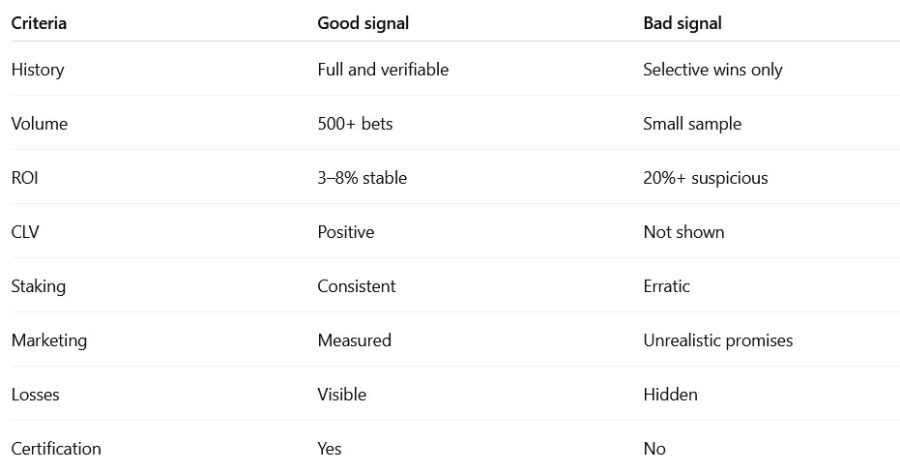
👉 Less than 5 criteria met: avoid
🧪 How to spot a fake tipster
A fake tipster:
- shows wins, not data
- talks about win rate, not ROI
- displays testimonials, not full records
- sells quickly
- avoids independent verification
👉 They sell conviction, not an edge.
⚠️ The typical pattern
- Build an “expert” image
- Show only winning bets
- Use social proof
- Launch paid offers quickly
- Disappear if results drop
👉 Without tracking, manipulation is undetectable.
🧠 The uncomfortable truth
- 90%+ of tipsters have no edge
- paying does not create an advantage
- truly profitable profiles are rare
👉 And most importantly:
A tipster without an edge is just a bettor… who charges you.
🔚 Conclusion
Paying for a tipster can make sense… but only under strict conditions:
- full transparency
- large sample size
- consistent ROI
- independent verification
- proven, sustainable edge
👉 Otherwise:
You’re just outsourcing your bets… without improving your results.
🎯 Final takeaway
A tipster shouldn’t convince you.
They should prove, with data, that they beat the market.
In my same category
Tipsters
Tipster Platform: Complete Comparison and Real Analysis of the Best Solutions (2026)
Wednesday, 15 April 2026
The tipster platform market has grown significantly in recent years. However, one reality remains:👉 most of the performance displayed is not truly reproducible.Why?Because most platforms measure performance poorly — or only partially.In this article, we ...
See the articleTipsters
Tipster Platform: Our Vision of Freedom and Transparency in Sports Betting Predictions
Wednesday, 18 February 2026
The market for sports betting tipster platforms is evolving rapidly. As bettors become more demanding, two criteria are emerging as essential: performance transparency and result verification.In this context, some platforms adopt exclusivity models for th...
See the articleTipsters
Market Liquidity: A Key Factor for Long-Term Success in Sports Betting
Saturday, 27 December 2025
Most bettors focus on odds, ROI, or win rate. However, one of the most decisive — and frequently overlooked — variables in sports betting is market liquidity. In practice, liquidity determines whether a strategy is merely profitable on paper or truly expl...
See the articleBet2Invest is not a bookmaker and does not offer sports betting services. However, its content relates to betting activities.
Gambling is strictly prohibited for minors. Gamble responsibly — excessive gambling can lead to financial loss, debt, or addiction.