Odds
What Are the Real Chances of Winning the Lottery ?
Understanding the real chances of winning the lottery requires diving into the fascinating realm of cognitive biases and probability. One of the key concepts to explore is optimism bias. This psychological phenomenon makes us believe that positive outcomes are more likely to happen to us than to others, while negative outcomes are less likely.
Our brains also struggle with small probabilities. When it comes to events that are statistically rare, we tend to misjudge the actual odds. This misperception often leads us to overestimate our chances of winning the lottery or avoiding unlikely misfortunes.
Lastly, it's crucial to understand the expected value of your bets. This concept helps quantify the average outcome of a given activity, guiding us to make more informed decisions. By understanding the expected value, lottery players can better grasp why the odds are stacked against them and why strategic planning in gambling is essential for long-term success.
Optimism Bias in Gambling
The human mind can be brilliantly rational, but it also often behaves irrationally. Psychologists call this a cognitive bias. Knowing these biases can help us make better decisions and, in the case of gambling, either profit or at least avoid losing money.
What is Optimism Bias ?
Optimism bias is the tendency to think that a negative event is less likely to happen to us than to others. In a group, this bias manifests as a “not me” mentality, making us believe that our chances of being struck by misfortune are slim.
Interestingly, this bias also works the other way around for positive events. For pleasant but unlikely events, our brain tends to exaggerate our chances. This is why people continue to buy lottery tickets, hoping the next draw will be theirs.
Classic examples of this bias include smokers who think they are less likely to get lung cancer than other smokers and traders who believe they are less exposed to losses than their peers.
If I Won the Lottery...
Behavioral studies show that our brains struggle with processing very low probabilities.
For example, we know that a fatal fall in the shower is rare, but we don't know exactly how rare. Is it more or less likely than dying in a terrorist attack on a plane? Or dying from accidental alcohol poisoning?
To illustrate the irrationality of decision-making regarding low-probability events, Nobel laureate Daniel Kahneman conducted an experiment on purchasing insurance. One group of Americans was offered insurance against death in a terrorist attack during a trip to Europe, while another group was offered insurance against any type of death for the same trip. Even though the “any type of death” insurance included the terrorist attack scenario, the first group was willing to pay more.
The odds of winning the jackpot in a 6/49 lottery are slim, about one in 14 million. In his book "Taking Chances," John Haigh compares these odds to our chances of death.
“If you are in good health and middle-aged, you might have a one in a thousand chance of dying in the next year, which means about a one in nine million chance of dying in the next hour. If you buy your ticket before 7:20 pm for a draw at 8:05 pm, you have more chance of dying before the draw than winning the jackpot. Sorry.”
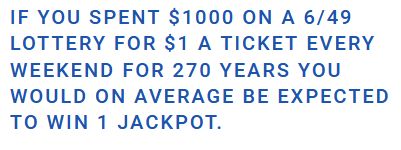
In other words, even if you spent €1,000 every weekend on €1 lottery tickets for 270 years, you should, on average, win the jackpot only once.
Why Do We Keep Playing the Lottery ?
Despite these overwhelming odds, why do we continue to buy lottery tickets? The answer lies partly in how our brain processes probabilities. It tends to ignore the less attractive but more probable outcomes, and here's how.
Misperception of Probabilities
Our brain is poorly equipped to evaluate low probabilities, preferring instead to rely on its ability to imagine the outcomes, known as availability bias.
Lottery winners are often highly publicized, leaving a lasting impression. You might think, “If they can do it, why not me?” making the idea of winning seem more plausible when in reality, it's very rare.
After the World Trade Center attacks, the vivid images of the events were easily recalled. It didn't matter that the odds of dying in a shower fall (one in 810,000) are 31 times higher than those of dying in a terrorist attack on a plane (one in 25 million). People were more obsessed with terrorism than their showers.

Survival of the Mathematically Fit
Why do lotteries remain so popular, even though the tickets have a negative expected value? Beyond the persistent hope, another bias reinforces this behavior.
In pure chance activities, “near-misses” (almost winning) are often perceived as signs of future success, although these results do not influence future probabilities at all.
We like to see ourselves as rational creatures, but even the brightest minds can fall victim to biases. It's almost impossible to predict which bias will apply in a given situation. To complicate things further, the same individual may exhibit different biases in identical situations.
Hoping to win the lottery is one way to invest your time and money. Another way is to develop a strategy with a positive expected value and apply it systematically. Statistics show that this latter approach is wiser.
Expected value is a key indicator for any profitable activity. It shows how much we can expect to win on average and represents the fundamental calculation for players, bettors, and investors. For more information, check out our article titled "How to Calculate Expected Value."
If you already know how to calculate expected value, you are ready to create your own betting strategy. Discover how to create a betting model with Dominic Cortis, a lecturer in the Department of Mathematics at the University of Leicester.
2024年7月31日水曜日
同じカテゴリ内
Odds
FIFA Club World Cup 2025: Opta’s Predictions
2025年6月13日金曜日
As the FIFA Club World Cup 2025 approaches, set to take place in the United States, the football world is closely watching this newly expanded 32-team tournament. Opta has released its data-driven predictions as of June 9, 2025, estimating each club’s cha...
記事を見るOdds
スポーツベッティングにおける「本当の実力」をどう測定するのか?
2025年3月15日土曜日
スポーツベッティングで「勝っている=実力がある」とは限らないスポーツベッティングでは、短期間で利益を出している人を見て「この人は本当に上手い」と判断してしまいがちです。しかし現実には、数週間や数か月の結果だけでは、実力と運を区別することは非常に困難です。偶然の連勝は存在します。 逆に、優秀なベッターでも長期間のマイナス収支に苦しむことがあります。だからこそ、本当に重要なのは「どれだけ勝ったか」ではなく、👉 その利益が再現可能なスキルによるものなのか?を測定することです。プロフェッショナルなベッティングの...
記事を見るOdds
分散の真実 ― スポーツベッティングにおける最大の誤解
2025年3月8日土曜日
📉 分散とは何か?スポーツベッティングにおいて、「分散(Variance)」は避けて通れない概念です。多くのベッターは、数回負けただけで「戦略が間違っている」と考えます。しかし実際には、短期的な結果は実力ではなく“確率の揺らぎ”によって大きく左右されます。分散とは簡単に言えば:期待される結果と、実際の結果との差を意味します。たとえプラス期待値(+EV)の戦略を使っていても、短期では損失が続くことがあります。逆に、長期的には負ける戦略でも、一時的に大勝ちすることもあります。つまり、短期間の結果だけでは「実...
記事を見るBet2Investはブックメーカーではなく、スポーツベッティングのサービスも提供していません。ただし、当サイトのコンテンツはスポーツベッティング活動に関連しています。
未成年者の賭博は固く禁じられています。責任あるプレイを — 過度な賭博は、金銭的損失、借金、依存につながる可能性があります。