Should You Increase Your Stakes When Your Bankroll Grows?
You start with a €5,000 Bankroll.
Your rule is simple:
1U = €50
or:
1% of your initial Bankroll.
After several months, your results are positive and your Bankroll reaches:
€5,500
then:
€6,000
and perhaps:
€7,500.
An obvious question then arises:
should you increase your Stakes when your Bankroll grows?
At first glance, the answer seems straightforward.
If 1U represents 1% of the Bankroll, a €6,000 Bankroll should mean:
1U = €60
And with €7,500:
1U = €75
Mathematically, this is consistent.
In practice, however, the question is more complex.
Increasing your Stakes too quickly can amplify Variance and Drawdowns.
On the other hand, never increasing your Stakes means you do not fully benefit from the growth of your capital.
The real question is therefore:
when and how should you recalculate the value of your Unit?
Two Main Approaches
There are two main ways to manage Stake size as your Bankroll changes.
Method 1: Keep a Fixed Unit
You start with:
Bankroll = €5,000
1U = €50
Even if your Bankroll reaches:
€6,000
you continue betting:
€50
per Unit.
The monetary value of your Unit therefore remains fixed.
Method 2: Recalculate the Unit Regularly
You decide that:
1U = 1% of the Bankroll
If the Bankroll increases to:
€6,000
then:
1U = €60
If it reaches:
€7,500
then:
1U = €75
This second approach allows the size of your Stakes to gradually increase with your capital.
However, it also changes the way your Bankroll behaves.
Why Keep a Fixed Unit?
The first reason is simplicity.
With:
1U = €50
every result is easy to track.
If your Tipster generates:
+20U
your profit is:
20 × €50 = €1,000
If the Tipster records:
-10U
your loss is:
10 × €50 = €500
The monetary value of each Unit never changes.
This makes performance analysis considerably easier.
A Fixed Unit Gradually Reduces Relative Risk
There is another interesting effect.
At the beginning:
Bankroll = €5,000
Stake = €50
Your Stake represents:
1% of the Bankroll
But if your Bankroll reaches:
€6,000
the same €50 Stake now represents:
0.83% of the Bankroll
At:
€7,500
€50 represents only:
0.67% of the Bankroll
At:
€10,000
€50 represents:
0.50%
Therefore, if the Bankroll grows while the Stake remains fixed, your relative level of risk gradually decreases.
This Makes the Strategy Increasingly Conservative
This development can be intentional.
Someone who wants to progressively protect accumulated profits may decide to keep a fixed Unit.
As the Bankroll grows, each bet represents a smaller fraction of the available capital.
All else being equal, the Risk of Ruin therefore decreases mechanically.
However, this additional caution also comes at a cost.
The growth of the capital is not being fully exploited.
Why Increase Stakes Gradually?
The alternative is to maintain a relatively stable percentage of the Bankroll.
For example:
1U = 1% of the Bankroll
With:
€5,000
1U = €50
With:
€6,000
1U = €60
With:
€7,500
1U = €75
With:
€10,000
1U = €100
This approach allows you to benefit from Bankroll growth.
As your capital increases, the monetary value of the same performance expressed in Units also increases.
The Compounding Effect
Suppose a strategy generates:
+20U
With a Fixed €50 Unit
The profit is:
20 × €50 = €1,000
With a €75 Unit
The same +20U result produces:
20 × €75 = €1,500
This is the principle of compounding applied to Stake Sizing.
As capital grows, the size of your positions can gradually increase.
But there is one essential condition:
the increase in Stakes should come from genuine Bankroll growth, not simply from increased confidence.
The Trap: Increasing Stakes After a Winning Run
This is probably one of the most common mistakes.
A bettor starts with:
1U = €50
Then generates:
+8U
over a few weeks.
The bettor immediately decides to increase to:
1U = €75
Why?
Because the strategy appears to be performing particularly well.
But a winning run does not necessarily mean that the Edge has increased.
It may simply represent a favorable period of Variance.
Increasing Stakes sharply after a good run can therefore lead to taking more risk just before results return to a less favorable period.
Bankroll and Confidence Are Not the Same Thing
Stake size should not increase simply because:
“I'm on a good run”
“my Tipster is winning a lot right now”
or:
“the strategy has just made +15U”
These factors alone are not sufficient justification.
The better question is:
“Has my Bankroll increased enough to objectively justify a new Unit value?”
This distinction helps prevent Performance Chasing.
Should You Recalculate Your Unit After Every Bet?
Technically, you can.
If you use exactly:
1% of the current Bankroll
then your Stake could be recalculated after every result.
For example:
Bankroll:
€5,000
Stake:
€50
After several wins, the Bankroll increases to:
€5,127
The new Unit would be:
€51.27
Then perhaps:
€51.84
then:
€50.96
and so on.
Mathematically, this method is consistent.
In practice, however, it can become unnecessarily complicated.
A Step-Based Approach Is Often Simpler
Instead of recalculating the Unit after every bet, you can define Bankroll thresholds.
For example:
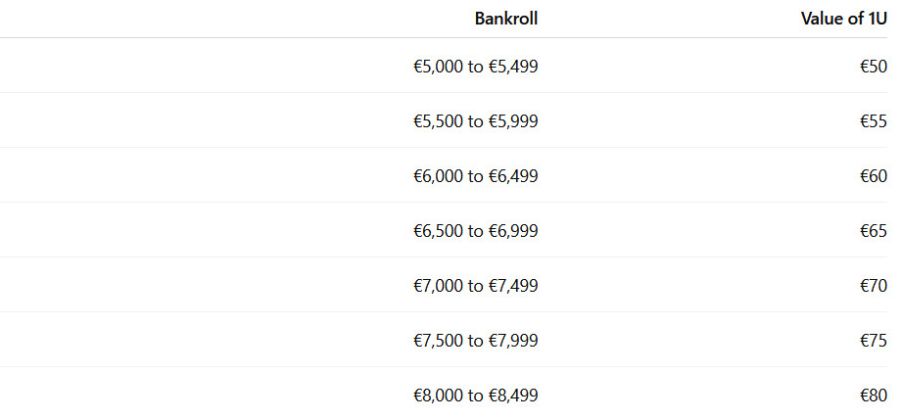
This method maintains a logic close to:
1U ≈ 1% of the Bankroll
while avoiding constant changes to your Stake.
A Step-Based System Reduces Constant Adjustments
With this method, the value of the Unit changes only when the Bankroll crosses a predefined threshold.
For example:
Initial Bankroll:
€5,000
1U:
€50
The Bankroll increases to:
€5,420
You continue with:
1U = €50
It then reaches:
€5,500
You increase to:
1U = €55
Then at €6,000:
1U = €60
This allows Stakes to grow with the Bankroll without changing the amount after every single bet.
Be Careful With Moving Back and Forth Between Thresholds
Imagine your Bankroll reaches:
€5,510
You therefore increase from:
€50
to:
€55
per Unit.
After a few losses, your Bankroll falls back to:
€5,470
Should you immediately return to €50?
And then move back to €55 if the Bankroll reaches €5,510 again?
This system can create constant Stake changes around the same threshold.
One solution is to use confirmation zones.
Use a Confirmation Threshold
For example, you can decide not to change your Unit until the Bankroll has sustainably crossed a certain level.
You can also recalculate at fixed intervals:
once a month
every three months
or:
after a predetermined increase in the Bankroll
This limits reactions to short-term fluctuations.
The objective is to adapt your Stake to a structural change in capital, not to every movement caused by Variance.
Another Method: Increase the Unit Every +10% in Bankroll
A particularly simple rule is to adjust the Unit whenever the Bankroll increases by a certain percentage.
For example:
+10%
Initial Bankroll:
€5,000
1U:
€50
First threshold:
€5,500
New Unit:
€55
Second threshold:
€6,050
New Unit:
€60.50
Third threshold:
€6,655
New Unit:
€66.55
This method allows Stake size to follow the growth of the capital progressively.
Can You Use Rounded Amounts?
Yes.
There is generally no need to bet exactly:
€60.50
or:
€66.55
A more practical approach could use:
€60
then:
€65
or:
€70
The objective is not to maintain exactly 1% down to the cent.
The objective is to maintain a consistent Risk Management framework.
The Problem With Increasing Stakes Too Quickly
Suppose your Bankroll increases from:
€5,000
to:
€6,000
You have gained:
20%
If you maintain a 1% approach, your Unit increases from:
€50
to:
€60
Your Stake has also increased by:
20%
This is consistent.
But imagine that you instead decide to increase directly from:
€50
to:
€100
Your Bankroll has increased by only 20%.
But your Stake has increased by:
100%
Your risk profile has completely changed.
Stake Growth Should Remain Proportional to Bankroll Growth
This is a fundamental principle.
If your Bankroll increases by 20%, increasing your Unit by approximately 20% maintains a similar level of relative risk.
However, increasing the Stake much faster than the Bankroll means increasing your exposure to risk.
For example:
Initial Situation
Bankroll:
€5,000
1U:
€50
Risk:
1%
After Growth
Bankroll:
€6,000
If 1U = €60:
1%
But if 1U = €100:
1.67%
You have therefore not simply increased your Stakes.
You have also changed your Risk Management strategy.
What Happens if a Drawdown Occurs After Increasing the Unit?
This is an essential question.
Suppose your Bankroll reaches:
€7,500
You increase your Unit to:
€75
Then you experience a Drawdown of:
-20U
The loss is:
20 × €75 = €1,500
Your Bankroll falls back to:
€6,000
If you continue betting €75, your Unit now represents:
1.25% of the Bankroll
Your relative risk has therefore increased.
You need to decide in advance what happens when the Bankroll decreases.
Should You Also Reduce Stakes When the Bankroll Falls?
If your objective is to maintain exposure close to a fixed percentage of the Bankroll, then yes.
The adjustment should work in both directions.
A growing Bankroll may justify increasing the Unit.
A falling Bankroll may justify reducing it.
Otherwise, the system becomes asymmetric:
you increase Stakes during winning periods,
but keep those higher Stakes during Drawdowns.
This can amplify losses.
Example of Adjusting in Both Directions
Suppose:
€5,000 → 1U = €50
The Bankroll increases to:
€6,000
You move to:
1U = €60
Then a Drawdown brings the Bankroll back to:
€5,000
If you want to maintain 1% exposure, the Unit should return to:
€50
The system therefore remains consistent.
But Should You Reduce It Immediately?
Not necessarily.
As with increases, you can use thresholds.
For example:

The rule then becomes mechanical.
The decision is no longer emotional.
Fixed Flat Betting or Proportional Flat Betting?
It is useful to distinguish between two approaches.
Fixed Monetary Flat Betting
You always bet:
€50
The monetary value of the Stake never changes.
Proportional Flat Betting
You always bet approximately:
1% of the Bankroll
The monetary value of the Unit therefore changes with your capital.
Both approaches are coherent.
But they do not produce exactly the same growth and risk profile.
The Advantage of Fixed Monetary Flat Betting
With a fixed €50 Unit:
maximum simplicity
easy performance comparison
gradual reduction in relative risk as the Bankroll grows
fewer Stake decisions
It is a particularly robust approach.
The Advantage of Proportional Flat Betting
With a Unit that remains close to 1%:
relative risk remains more stable
capital growth is used more effectively
Stakes gradually increase with the Bankroll
Stakes can also decrease during Drawdowns
This approach creates a form of compounding.
Comparison When the Bankroll Doubles
Suppose the Bankroll increases from:
€5,000
to:
€10,000
Fixed Unit
1U remains:
€50
The Stake now represents:
0.5% of the Bankroll
Proportional Unit
1U becomes:
€100
The Stake remains:
1% of the Bankroll
Both methods are conservative in different ways.
The first gradually reduces relative risk.
The second maintains relatively stable risk while making greater use of capital growth.
Pay Attention to Maximum Drawdown
Before increasing a Unit, it is useful to ask:
what would the financial impact of the historical Maximum Drawdown be with this new Unit?
Suppose a strategy has experienced a Maximum Drawdown of:
-30U
With:
1U = €50
that represents:
-€1,500
With:
1U = €75
that represents:
-€2,250
With:
1U = €100
that represents:
-€3,000
The Drawdown expressed in Units remains identical.
But its financial impact changes considerably.
The Drawdown Must Remain Psychologically Manageable
Risk Management is not only about mathematics.
You also need to be able to continue following the strategy during difficult periods.
A theoretically appropriate Stake that becomes psychologically impossible to tolerate may cause you to abandon the strategy at the worst possible time.
Before increasing your Stakes, ask yourself:
“Can I financially and psychologically tolerate a historical Drawdown with this new Unit?”
Sample Size Remains Important
An increase in Bankroll over a small Sample Size does not necessarily prove that the strategy is more robust than it was initially.
Suppose your Bankroll increases from:
€5,000
to:
€6,000
after only:
100 bets
This is an excellent result.
But 100 bets still represent a relatively limited sample.
Part of the result may simply come from Variance.
By contrast, growth achieved over several thousand bets provides more information about the robustness of the strategy.
ROI and CLV Can Complement the Analysis
Before significantly changing the size of your Stakes, several indicators can be considered:
ROI
CLV
Sample Size
Maximum Drawdown
Variance
Flat Stakes Summary (1U)
Average Odds
and:
Liquidity
Bankroll growth is important.
But it should not necessarily be the only indicator used when deciding on a significant increase in capital exposure.
Pay Attention to Liquidity as the Bankroll Grows
This point is often overlooked.
A strategy may work perfectly with:
1U = €50
But if the Bankroll grows significantly and:
1U = €500
then:
1U = €1,000
the situation changes.
Can you actually place these Stakes at the same Odds?
On highly liquid markets, this may be relatively straightforward.
On:
niche sports
or secondary markets, it may become much more difficult.
Bankroll Scalability
A truly scalable strategy should allow the amount of capital deployed to increase progressively without significantly deteriorating execution conditions.
This can be described as:
Bankroll Scalability.
A strategy may be highly profitable with a €5,000 Bankroll but much harder to operate with a €500,000 Bankroll.
Why?
Because the Liquidity available at the desired Odds may no longer be sufficient.
The ability to increase Stakes therefore also depends on the market.
A Larger Bankroll Does Not Mean Every Stake Must Increase
This distinction becomes particularly important when using several Tipsters or strategies.
Some markets can easily absorb larger Stakes.
Others cannot.
For example, increasing from:
€50 to €100
may be straightforward in a highly liquid market.
Doing the same in a niche market may be much more difficult.
Bankroll growth may therefore lead to different capital allocations between strategies.
A Simple Rule: Never Increase Risk Faster Than Capital
This is probably one of the easiest principles to remember.
If your Bankroll increases by:
20%
increasing your Stake by:
20%
approximately maintains the same relative risk.
But increasing the Stake by:
50%
or:
100%
means you are taking more risk than before.
That is no longer simply compounding.
It is a change in your Risk Management.
Example of Structured Growth
Consider an initial Bankroll of:
€5,000
with:
1U = €50
A structured progression could look like this:
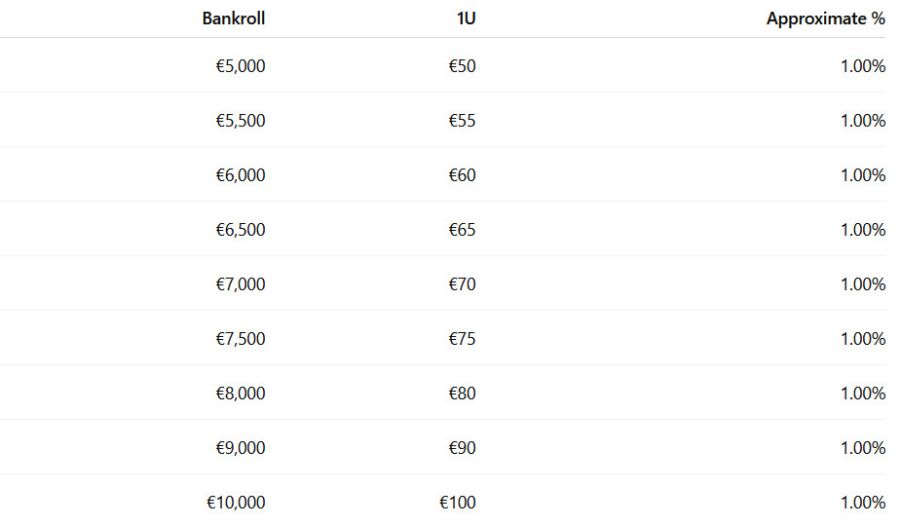
This progression is simple.
The Bankroll increases.
The Unit increases proportionally.
But the relative level of risk remains approximately stable.
What if You Regularly Withdraw Profits?
The situation changes.
Imagine your Bankroll reaches:
€6,000
but you withdraw:
€1,000
Your operational Bankroll returns to:
€5,000
It would be inconsistent to calculate your Unit based on €6,000 if only €5,000 actually remains available for betting.
The value of the Unit should normally be calculated using:
the capital actually available to absorb losses.
Actual Bankroll and Cumulative Profits Are Not the Same Thing
Suppose:
Initial capital:
€5,000
Cumulative profits:
+€3,000
Withdrawals:
€2,000
Capital actually available:
€6,000
Your cumulative performance remains:
+€3,000
But your operational Bankroll is:
€6,000
If you use a proportional method, this operational Bankroll should be the reference for determining your Unit size.
Should You Increase Your Stakes After Doubling Your Bankroll?
If your Bankroll sustainably grows from:
€5,000
to:
€10,000
and your strategy remains compatible with:
1U = 1%
then gradually increasing from:
€50
to:
€100
is mathematically consistent.
However, several questions should be considered:
Is the Drawdown still acceptable?
Is Liquidity sufficient?
Is the Sample Size large enough?
Does the Edge still appear to be present?
Can the new Stakes still be executed at the desired Odds?
Bankroll growth may allow you to increase Stakes.
It does not require you to do so.
A Conservative Approach: Increase Stakes More Slowly Than the Bankroll
There is also a third option.
You can choose to increase your Stakes more slowly than your Bankroll.
For example:
Initial Bankroll:
€5,000
1U:
€50
Bankroll:
€6,000
Instead of increasing to €60, you increase to:
€55
Bankroll:
€7,500
Instead of increasing to €75, you increase to:
€65
Bankroll:
€10,000
Instead of increasing to €100, you increase to:
€80
Relative risk gradually decreases, but you still benefit partially from capital growth.
Three Possible Approaches
Ultimately, there are three main approaches.
1. Completely Fixed Unit
The Bankroll grows but:
1U remains €50
Relative risk gradually decreases.
2. Proportional Unit
You maintain:
1U ≈ 1% of the Bankroll
Relative risk remains relatively stable.
3. Semi-Proportional Unit
You increase Stakes as the Bankroll grows, but more slowly than the capital itself.
Relative risk gradually decreases while still allowing some compounding.
None of these approaches is universally optimal.
They correspond to different objectives in terms of growth and risk control.
The Rule Should Be Defined Before the Results
This is probably the most important point.
It is better to decide in advance:
when the Unit increases
how much it increases
when it decreases
how often it is recalculated
and:
what Stake Caps apply
A predefined rule reduces the risk of making emotional decisions after a winning or losing streak.
Example of a Complete Rule
A bettor could decide:
Initial Bankroll: €5,000
Initial Unit: €50
Recalculation: once a month
Target Unit: approximately 1% of the Bankroll
Rounding: in €5 increments
Increase only when the Bankroll confirms a new threshold
Reduce the Unit if the Bankroll falls significantly
Stake Cap according to market Liquidity
This rule is simple.
It is measurable.
And most importantly:
it is defined before the next results are known.
Mistakes to Avoid
- Doubling your Stakes after a winning run.
- Confusing Bankroll growth with an increase in Edge.
- Emotionally recalculating your Unit after every result.
- Increasing Stakes much faster than the Bankroll.
- Increasing Stakes but refusing to reduce them during a Drawdown.
- Ignoring historical Maximum Drawdown.
- Ignoring Variance.
- Ignoring Sample Size.
- Ignoring Liquidity.
- Treating withdrawn profits as if they were still part of the Bankroll.
- Increasing Stake simply because a strategy has recently performed extremely well.
- Failing to define a progression rule in advance.
- Confusing capital growth with an automatic improvement in the strategy.
- Ignoring the psychological impact of larger monetary Stakes.
- Forgetting that Risk of Ruin is directly affected by Stake size.
Conclusion
So:
should you increase your Stakes when your Bankroll grows?
It can be perfectly consistent to do so.
But the increase should not be an emotional reaction to profits.
It should follow a predefined Risk Management rule.
With an initial Bankroll of:
€5,000
and:
1U = €50 = 1%
a progression toward:
€6,000 → 1U ≈ €60
then:
€7,500 → 1U ≈ €75
and:
€10,000 → 1U ≈ €100
maintains approximately the same level of relative risk.
However, keeping a fixed Unit or increasing Stakes more slowly than the Bankroll are also perfectly valid approaches.
The choice depends on factors such as:
your desired level of risk
Maximum Drawdown
Variance
Sample Size
Liquidity
and:
Bankroll Scalability.
The essential question is therefore not:
“I've made money, can I bet more now?”
But rather:
“Has my Bankroll grown enough for an increase in my Unit to remain consistent with the level of risk I originally defined?”
FAQ: Should You Increase Your Stakes When Your Bankroll Grows?
Should You Increase Your Stake After Every Win?
No. A single win or a short winning streak does not necessarily justify changing your Stake. A threshold-based method or periodic recalculation is generally more structured.
If My Bankroll Increases by 20%, Should I Increase My Stakes by 20%?
If your objective is to maintain the same percentage of Bankroll per Unit, this is mathematically consistent. However, there is no requirement to increase your Stakes at the same rate.
Can I Keep the Same Unit Even if My Bankroll Doubles?
Yes. If your Bankroll increases from €5,000 to €10,000 while your Unit remains €50, your Stake simply decreases from 1% to 0.5% of the Bankroll. Your approach becomes more conservative.
Should You Reduce Stakes When the Bankroll Falls?
If you use a proportional method, yes. This helps maintain a more stable level of relative risk during Drawdowns.
How Often Should You Recalculate Your Unit?
There is no universal frequency. It can be recalculated monthly, quarterly or according to predefined Bankroll thresholds. The important point is to define the rule in advance.
Does a Winning Streak Justify Increasing the Stake?
Not necessarily. A winning streak may simply result from Variance. It does not prove that the strategy's Edge has increased.
Why Use Bankroll Thresholds?
Thresholds prevent you from changing your Stake after every small Bankroll fluctuation. They create a more stable and manageable progression.
Can Liquidity Prevent You From Increasing Stakes?
Yes. As the Bankroll becomes larger, some markets may no longer allow the desired Stakes to be executed at the same Odds. This is an important limitation on Bankroll Scalability.
Should Withdrawn Profits Be Included in the Bankroll?
No, if they are no longer available to absorb losses. For Stake Sizing purposes, it is more consistent to use the Bankroll that is actually available.
What Is the Most Important Rule?
Do not increase risk faster than your capital unless you have consciously decided to change your Risk Management profile.
Sunday, 27 September 2026
Bet2Invest is not a bookmaker and does not offer sports betting services. However, its content relates to betting activities.
Gambling is strictly prohibited for minors. Gamble responsibly — excessive gambling can lead to financial loss, debt, or addiction.