Education
Flat Betting: Why Always Bet the Same Unit?
Thursday, 3 September 2026
Once you have defined your bankroll and decided how much of it to risk per wager, another important question arises:
Should you always bet the same amount, or should you adjust your stake according to your level of confidence?
Many bettors are tempted to vary their stakes.
A bet considered “very strong” might receive 2U or 3U.
A bet seen as more uncertain might receive only 0.5U or 1U.
On paper, this seems intuitive.
But it raises an important issue:
Are we really able to estimate our edge accurately enough to adjust the size of each wager correctly?
Flat Betting takes a much simpler approach:
betting the same unit on every wager.
In this fourth article in our bankroll management series, we will explain what Flat Betting is, why it is particularly useful for measuring the true performance of a strategy, and when it may be preferable to variable staking.
What Is Flat Betting?
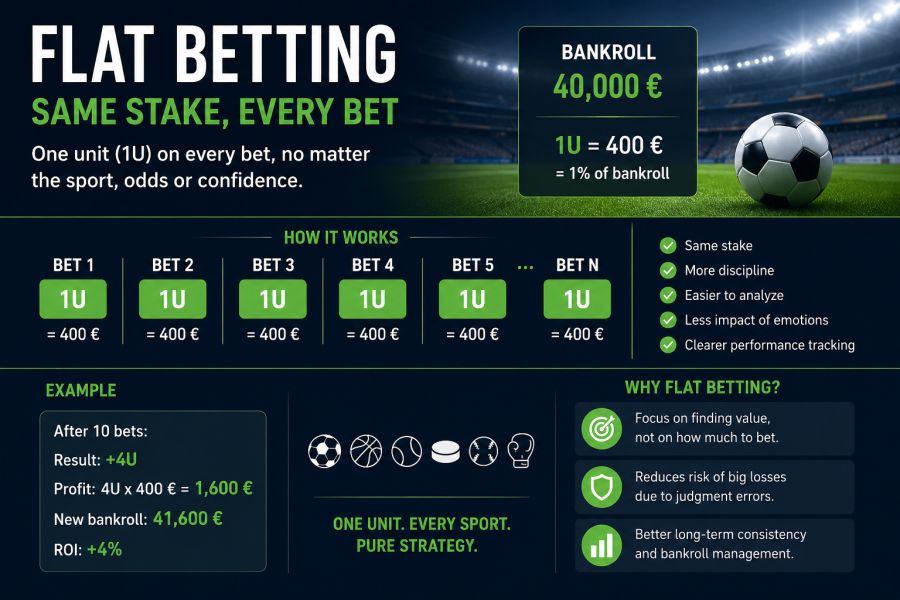
Flat Betting means using exactly the same stake on every wager.
If your unit is defined as:
1U = €50
then every wager is placed with:
€50
regardless of:
- the sport;
- the competition;
- the odds;
- your subjective level of confidence;
- the results of previous wagers.
Throughout this series, we use a fictional bankroll of:
€5,000
with:
1U = €50
which represents:
1% of the starting bankroll
A Flat Betting system would therefore simply look like this:
Bet 1: €50
Bet 2: €50
Bet 3: €50
Bet 4: €50
and so on.
The logic is extremely simple.
Why Is Flat Betting So Useful?
The main advantage of Flat Betting is that it clearly separates two elements:
the quality of the selections
and
the way stakes are managed.
If every bet is placed at exactly 1U, the final result reflects the quality of the betting strategy much more directly.
It becomes easier to answer the question:
“Does this strategy actually identify profitable betting opportunities?”
With variable staking, things become more complicated.
A good strategy can lose money because the largest stakes were placed on the wrong selections.
Conversely, a mediocre strategy can temporarily show strong results simply because a few large-stake bets happened to win.
Flat Betting reduces this distortion.
A Simple Example With Our €5,000 Bankroll
Let us return to our reference:
Bankroll: €5,000
1U: €50
Suppose a series of 10 bets produces a result of:
+4U
With Flat Betting:
4 × €50 = +€200
The bankroll rises from:
€5,000 to €5,200
which represents:
+4%
The calculation is immediate.
If the strategy produces:
+20U
the result is:
+€1,000
or:
+20% of the starting bankroll
in our fixed-unit model.
This simplicity makes performance analysis much easier.
Flat Betting and the True Performance of a Strategy
Now imagine two tipsters selecting exactly the same 100 bets.
The first always uses:
1U
The second uses stakes ranging from:
0.5U to 5U
The second tipster's result now depends on two different skills:
1. The ability to select good bets
2. The ability to size each stake correctly
That makes the analysis much more difficult.
If the tipster posts a strong profit, is it because the selections were good?
Or because a few of the largest stakes happened to win?
With a Flat Stakes Summary at 1U, the question becomes much easier:
What would the result have been if every selection had been bet with exactly the same unit?
This is particularly useful when comparing different strategies.
Why Fixed Units Make Tipsters Easier to Compare
Imagine two tipsters.
Tipster A
Actual result:
+35U
But stakes range from 1U to 5U.
Tipster B
Actual result:
+20U
With every selection played at 1U.
At first glance, Tipster A appears better.
But suppose we recalculate Tipster A's selections using Flat Betting at 1U and the result drops to:
+8U
That changes the interpretation considerably.
A significant part of the performance came from stake sizing rather than selection quality alone.
Tipster B, with:
+20U at Flat Stakes
demonstrates a more robust selection performance.
This is why a metric such as Flat Stakes Summary (1U) can be extremely valuable when evaluating tipsters.
Flat Betting and ROI
Flat Betting also makes ROI easier to calculate.
Suppose you place:
100 bets
at:
€50 per bet
The total amount staked is:
100 × €50 = €5,000
If the final profit is:
€250
then:
ROI = €250 / €5,000 = 5%
The calculation is very straightforward.
With variable stakes, every amount must be added together before the true ROI can be calculated.
That is perfectly possible.
But it makes analysis less intuitive and comparisons more complex.
Does Flat Betting Remove Emotion?
Not completely.
But it significantly reduces the influence of emotion on stake sizing.
A bettor might think:
“I really like this one.”
With variable staking, that feeling may lead them to move from:
1U to 3U
But subjective confidence is not necessarily correlated with the true Expected Value of a wager.
Flat Betting imposes a simple rule:
a bet that meets the strategy criteria = 1U
This helps prevent personal conviction from becoming additional financial risk.
The Trap of the “Very Safe Bet”
Language itself can become dangerous in sports betting.
You often hear phrases such as:
“This one is safe.”
“This deserves 3U.”
“I'm sure this will win.”
But no sports bet is guaranteed.
Even an event with a high probability of success can lose.
Suppose a bettor normally stakes:
€50
But considers one bet exceptionally safe and stakes:
€250
or:
5U
If that bet loses, a single subjective decision wipes out the equivalent of:
five losing Flat Betting wagers.
A mistake in confidence assessment can therefore have a disproportionate effect on the bankroll.
Flat Betting vs Variable Staking

Is Flat Betting Optimal?
Not necessarily.
Suppose a bettor can estimate the Expected Value of each wager very accurately.
One bet may offer an estimated edge of:
+2%
while another offers:
+10%
In theory, it may make sense to allocate more capital to the second opportunity.
This is precisely the reasoning behind stake-sizing methods such as the Kelly Criterion.
But there is one major condition:
the true edge must be estimated accurately.
And that is far from easy.
If the estimate is wrong, variable staking can amplify the mistake.
Flat Betting therefore sacrifices part of the potential theoretical optimisation in exchange for:
simplicity, stability and robustness.
Estimation Errors Become More Dangerous With Variable Stakes
Consider two bets.
Bet A
The bettor believes the edge is very strong.
Stake:
4U = €200
Bet B
The bettor believes the edge is smaller.
Stake:
1U = €50
Now suppose the assessment was wrong.
Bet A actually had no edge.
Bet B was the better opportunity.
The bettor therefore allocated four times more capital to the weaker position.
With Flat Betting:
€50 would have been staked on each bet.
The analytical mistake would still exist.
But its financial impact would be smaller.
This is one of the major advantages of Flat Betting:
it reduces the cost of errors in conviction.
Flat Betting and Variance
Flat Betting obviously does not eliminate variance.
Even with a constant stake of 1U, a strategy can experience:
- five consecutive losses;
- ten consecutive losses;
- significant drawdowns;
- several losing weeks.
But the financial consequences become easier to measure.
With our unit of:
€50
ten losses represent:
-€500
or:
-10U
and:
-10% of the starting bankroll
The relationship between betting results, units and bankroll remains simple.
This makes risk easier to analyse.
Why a Fixed Unit Improves Discipline
Discipline is often underestimated.
Without a clear staking rule, a bettor can easily move from:
1U
to:
2U
and then:
3U
depending on:
- confidence;
- a winning streak;
- a losing streak;
- the desire to recover quickly;
- the perceived importance of a match.
Over time, bankroll management can become inconsistent.
With Flat Betting:
the stake decision is made before the bet itself is even known.
The bettor no longer asks:
“How much should I stake?”
The only question becomes:
“Does this selection meet the criteria of my strategy?”
If yes:
1U
If not:
no bet.
Flat Betting and Chasing Losses
Flat Betting also helps protect against chasing.
Suppose a bettor loses:
3 consecutive bets
With a fixed unit:
-3U
The next bet is still:
1U
But an emotional bettor might think:
“I'll stake 4U to recover my losses.”
A normal losing sequence has now been transformed into a much larger risk.
Flat Betting imposes a clear principle:
a loss does not change the size of the next stake.
Previous results do not automatically alter the Expected Value of the next wager.
Should You Bet 1U at All Odds?
This is a more subtle question.
Consider two bets.
Bet A
Odds:
1.50
Bet B
Odds:
5.00
Under strict Flat Betting, both receive:
1U
Yet their variance profiles are obviously different.
A strategy based on high odds will generally experience more losses and larger fluctuations.
Flat Betting must therefore always be analysed together with the statistical profile of the strategy.
Using 1U everywhere does not mean all strategies carry the same risk.
The distribution of odds remains important.
Flat Betting and a Portfolio of Strategies
Now suppose a bettor follows several strategies.
With a bankroll of:
€5,000
and:
1U = €50
they may use:
Strategy A
1U per bet
Strategy B
1U per bet
Strategy C
1U per bet
But if many bets are open at the same time, total exposure increases.
For example:
10 open bets × €50 = €500
which represents:
10% of the bankroll
Flat Betting simplifies the size of each individual position.
But it does not remove the need to monitor:
total portfolio exposure.
This becomes particularly important when following several tipsters or strategies simultaneously.
Should the Same Unit Be Used Forever?
Not necessarily.
It is important to distinguish between:
Flat Betting
and
a permanently fixed euro amount.
A bettor may decide:
1U = €50
for a given period.
If the bankroll later grows sustainably from:
€5,000 to €6,000
the bettor may recalibrate the unit.
For example:
1% of €6,000 = €60
From that point, every wager can be placed at:
1U = €60
The method is still Flat Betting.
Only the value of the unit has been adjusted.
We will explore this question in a dedicated article:
Should you increase your stakes when your bankroll grows?
Flat Betting or Dynamic Percentage Staking?
There is an important difference between:
Flat Betting: €50 on every wager
and:
staking 1% of the current bankroll on every wager
Suppose the bankroll falls from:
€5,000 to €4,000
With Flat Betting:
the stake remains €50
It now represents:
1.25% of the current bankroll
With proportional staking:
1% of €4,000 = €40
The stake decreases.
Now suppose the bankroll rises to:
€6,000
Flat Betting:
€50
Proportional staking:
€60
These two approaches serve different objectives.
Flat Betting prioritises:
stability and readability.
Proportional staking focuses more on:
continuous adaptation to bankroll size.
Why Is the Flat Stakes Summary (1U) Useful?
When analysing a strategy or tipster, the Flat Stakes Summary (1U) answers a fundamental question:
“What would have happened if every selection had been played with exactly the same stake?”
This metric removes the influence of variable stake sizing.
It therefore helps isolate:
the quality of the selections.
Suppose a tipster shows:
+40U actual result
but only:
+10U in Flat Stakes (1U)
This tells us that stake sizing played a major role in the final performance.
Now consider another tipster showing:
+25U actual
and:
+23U in Flat Stakes (1U)
Their performance is far less dependent on stake variation.
That is useful information when evaluating the robustness of a track record.
Flat Betting Does Not Turn a Bad Strategy Into a Good One
This point is essential.
Good bankroll management does not create an edge.
If a strategy has negative Expected Value, betting 1U on every selection will not make it profitable.
Flat Betting can:
- control risk;
- simplify analysis;
- reduce stake-sizing errors;
- improve discipline.
But it cannot transform losing bets into winning ones.
You must therefore distinguish between:
strategy quality
and
money management quality.
Both matter.
When Is Flat Betting Particularly Useful?
Flat Betting can be especially relevant when:
- starting structured bankroll management;
- testing a new strategy;
- evaluating a tipster;
- comparing different systems;
- your estimate of edge is uncertain;
- you want to reduce emotional influence;
- you want performance to be as easy to interpret as possible.
It provides a very robust foundation.
When Can Variable Stakes Make Sense?
Variable staking can become relevant when you have sufficiently reliable information to distinguish between opportunities.
For example:
Bet A: estimated edge +2%
Bet B: estimated edge +8%
If those estimates are genuinely robust, staking more on Bet B may be rational.
But that is precisely the difficult part:
the edge must be estimated correctly.
A poor estimate combined with a large stake can cause more damage than an incorrect selection made under Flat Betting.
Variable staking systems therefore generally require a more advanced level of analysis.
Flat Betting: Simplicity vs Optimisation
The comparison can be summarised as follows.
Flat Betting primarily seeks to maximise:
robustness + discipline + clarity
Variable staking methods aim more toward:
capital efficiency + theoretical growth
The second approach may be superior if the estimates are accurate enough.
The first is often more resistant to human and statistical errors.
That distinction is fundamental.
Conclusion
Flat Betting means using exactly the same unit on every wager.
In our example:
Bankroll: €5,000
1U: €50
Every qualifying bet is therefore placed with:
€50
This method offers several important advantages:
- simplicity;
- discipline;
- clearer performance measurement;
- easier comparison between strategies;
- reduced emotional influence;
- lower risk of stake-sizing errors.
Flat Betting is not necessarily mathematically optimal in every situation.
But it has one particularly important quality:
it is robust.
It makes it easier to assess the true quality of a strategy without stake variations distorting the analysis.
This is precisely why the Flat Stakes Summary (1U) can be such a valuable metric when evaluating tipster performance.
In the next article, we will explore the concept behind this metric in greater detail:
What is a unit (1U) in sports betting, and why has it become a standard way of measuring performance?
FAQ: Flat Betting in Sports Betting
What is Flat Betting?
Flat Betting means staking exactly the same amount on every wager. If 1U equals €50, every selection is played with €50 regardless of your confidence level or previous results.
Why use Flat Betting?
Flat Betting simplifies bankroll management, makes ROI easier to calculate, reduces emotional influence and helps measure the quality of a strategy or tipster's selections more directly.
Is Flat Betting profitable?
Flat Betting is not profitable by itself. Profitability depends on the quality of the underlying selections. A negative Expected Value strategy will remain unprofitable even with excellent bankroll management.
Should you always bet 1U?
1U is a practical reference, but its monetary value depends on bankroll size and risk tolerance. In our example, 1U represents 1% of a €5,000 bankroll, or €50.
What is the difference between Flat Betting and variable staking?
Flat Betting uses the same stake on every wager. Variable staking increases or decreases the stake according to estimated edge, confidence or other criteria. Variable stakes can theoretically be more efficient when edge is accurately measured, but they also increase the risk of stake-sizing errors.
Can you increase the value of 1U when your bankroll grows?
Yes. Flat Betting means using the same unit for each selection during a given period. The monetary value of that unit can be recalibrated when the bankroll changes significantly.
Why analyse tipsters using Flat Stakes (1U)?
A Flat Stakes Summary (1U) recalculates every selection using the same stake. This removes the influence of variable stake sizing and provides a clearer view of the underlying quality of the selections.
In my same category
Education
Why Doubling Your Stake After a Loss Is a Bad Strategy
Tuesday, 6 October 2026
You have a €5,000 Bankroll. Your usual rule is simple: 1U = €50 which represents: 1% of your Bankroll. You place a €50 bet. It loses. An idea may then seem appealing: double your next Stake to recover the loss. So you bet: €100 If this second bet wins at ...
See the articleEducation
Should You Reduce Your Stakes After a Losing Streak?
Tuesday, 29 September 2026
You have a €5,000 Bankroll. Your initial rule is simple: 1U = €50 or: 1% of your Bankroll. Your strategy has been working for several months. Then a difficult period begins. You lose: -5U then: -10U and eventually your Drawdown reaches: -15U Your Bankroll...
See the articleEducation
Should You Increase Your Stakes When Your Bankroll Grows?
Sunday, 27 September 2026
You start with a €5,000 Bankroll. Your rule is simple: 1U = €50 or: 1% of your initial Bankroll. After several months, your results are positive and your Bankroll reaches: €5,500 then: €6,000 and perhaps: €7,500. An obvious question then arises: should yo...
See the articleBet2Invest is not a bookmaker and does not offer sports betting services. However, its content relates to betting activities.
Gambling is strictly prohibited for minors. Gamble responsibly — excessive gambling can lead to financial loss, debt, or addiction.