What Is a Unit (1U) in Sports Betting?
In sports betting, you will often see results expressed like this:
+12U
+35.4U
-8U
or:
ROI: +5.2% | Profit: +24U
But what does the letter U actually mean?
The U simply stands for Unit.
A unit is a reference used to express bet size and measure the performance of a bettor, tipster, or betting strategy independently of the actual amount of money being wagered.
This means that two bettors with completely different bankrolls can use exactly the same risk-management framework.
Throughout our Bankroll Management series, we use a hypothetical bankroll of:
€5,000
with:
1U = €50
which represents:
1% of the starting bankroll.
In this article, we will explain exactly what a unit is, how to determine its value, why betting performance is often expressed in units, and why the Flat Stakes Summary (1U) can be particularly useful when analysing a strategy or tipster.
What is a unit in sports betting?
A unit is a standardised measure of bet size.
Instead of thinking directly in euros, a bettor can think in units.
For example:
Bankroll: €5,000
1U = €50
A stake of:
€50 = 1U
A stake of:
€25 = 0.5U
A stake of:
€100 = 2U
A stake of:
€150 = 3U
The unit therefore becomes a common language for expressing the level of exposure on a bet without needing to know the bettor's exact bankroll.
Why use units instead of euros?
Consider two bettors.
Bettor A
Bankroll:
€1,000
They define:
1U = €10
Bettor B
Bankroll:
€20,000
They define:
1U = €200
The monetary amounts are very different.
But in both cases:
1U = 1% of the bankroll
If both bettors place the same selection at 1U, their relative exposure is identical.
The first bettor risks:
€10
The second:
€200
But both are risking:
1% of their capital.
This is precisely the advantage of using units.
They allow strategies to be compared independently of bankroll size.
A unit does not have a universal monetary value
This is a fundamental point.
1U does not automatically mean €10, €50, or €100.
The value of 1U depends on the bankroll and the risk-management system being used.
For one bettor:
1U = €10
For another:
1U = €50
For another:
1U = €500
The monetary amount is therefore not the essential information.
What really matters is:
the proportion of the bankroll represented by 1U.
In our educational example:
Bankroll = €5,000
1U = €50
therefore:
1U = 1% of the starting bankroll
How do you determine the value of 1U?
A simple method is to define 1U as a percentage of your bankroll.
For example, with a bankroll of:
€5,000
you could use:

However, these configurations clearly do not carry the same level of risk.
A unit representing 0.5% of the bankroll provides a much larger safety margin than a unit representing 5%.
This is why the definition of 1U should not be arbitrary.
It is an integral part of Bankroll Management.
Why do we use 1U = 1% in this series?
In our example:
Bankroll: €5,000
1U: €50
We therefore have:
100 theoretical units
because:
€5,000 / €50 = 100
This structure makes bankroll movements very easy to understand.
For example:
+10U = +€500 = +10% of the starting bankroll
-10U = -€500 = -10%
+25U = +€1,250 = +25%
-20U = -€1,000 = -20%
Tracking performance becomes extremely intuitive.
This does not mean that 1% is a universal or mathematically optimal rule for every strategy.
It is primarily a practical benchmark for understanding risk and performance.
1U makes performance easier to compare
Imagine two bettors.
Bettor A
Bankroll:
€5,000
1U:
€50
Result:
+20U
Profit:
+€1,000
Bettor B
Bankroll:
€50,000
1U:
€500
Result:
+20U
Profit:
+€10,000
In euros, the results look completely different.
But both bettors have achieved:
+20U
If 1U represents 1% of the starting bankroll in both cases, their relative performance is identical:
+20%
Units therefore neutralise the size of the capital when comparing performance.
Why do tipsters publish their results in units?
When a tipster publishes selections, they do not know the bankroll size of every follower.
It would therefore make little sense to simply say:
“Bet €100.”
For one follower, €100 might represent:
0.2% of their bankroll
For another:
5%
or even more.
Saying:
“Stake: 1U”
is much more useful.
Each bettor can convert that unit according to their own bankroll.
If your 1U is:
€20
you bet €20.
If your 1U is:
€50
you bet €50.
If your 1U is:
€200
you bet €200.
The recommendation can therefore be adapted proportionally to each bettor's capital.
How do you convert units into euros?
The formula is very simple:
Profit or loss in € = Result in U × Value of 1U
Using our benchmark:
1U = €50
we get:
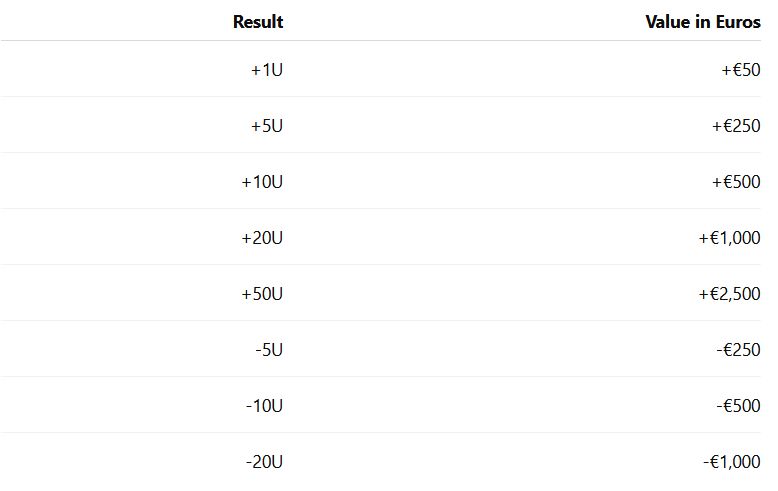
This allows you to convert standardised performance into its actual impact on your own bankroll immediately.
1U and Flat Betting
In the previous article, we looked at Flat Betting.
The principle was simple:
Every bet = 1U
With our bankroll:
1U = €50
Every bet is therefore placed with:
€50
Bet 1:
1U
Bet 2:
1U
Bet 3:
1U
Bet 4:
1U
And so on.
In this case, the unit serves two purposes:
it defines the size of the stake
and:
it measures the performance of the strategy.
How do you calculate a result in units?
Suppose you place:
1U
at odds of:
2.00
If the bet wins:
Profit = +1U
If the bet loses:
Loss = -1U
At odds of:
1.80
a winning 1U stake generates:
+0.80U
At odds of:
3.00
it generates:
+2U
The formula is:
Profit in U = Stake × (Odds - 1)
For a 1U stake at odds of 2.50:
1 × (2.50 - 1) = +1.50U
If the bet loses:
-1U
This method makes it possible to record every result without working directly in monetary amounts.
Example of a series of bets expressed in units
Consider five Flat Betting selections.
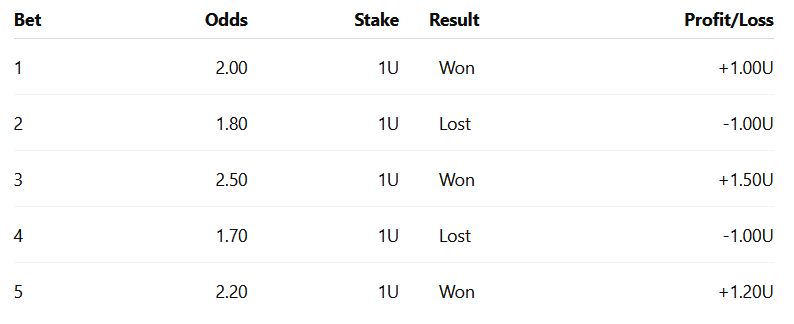
Total result:
+1.70U
With:
1U = €50
this represents:
1.70 × €50 = +€85
The bankroll therefore moves from:
€5,000 to €5,085
Is performance in units enough to judge a strategy?
No.
This is an extremely important distinction.
Suppose a strategy shows:
+30U
That may look attractive.
But a lot of information is still missing.
Were those +30U generated over:
100 bets?
1,000 bets?
10,000 bets?
At what odds?
With what ROI?
With what Drawdown?
Over what period?
With what market liquidity?
Performance expressed in units is useful.
But it needs to be analysed alongside other metrics.
+20U over 100 bets or +20U over 2,000 bets?
These two performances tell very different stories.
Strategy A
100 bets
Result:
+20U
Strategy B
2,000 bets
Result:
+20U
The profit in units is identical.
But the statistical profiles are completely different.
The first strategy shows much stronger performance relative to the number of bets, but over a limited sample size.
The second has a much larger track record, but a lower relative performance.
The number of units should therefore never be analysed in isolation.
Units vs ROI: what is the difference?
Units measure the profit or loss.
ROI measures the return relative to the total amount wagered.
Suppose:
100 bets
at:
1U per bet
Total turnover:
100U
Result:
+5U
The ROI is:
5 / 100 = 5%
Now suppose:
500 bets
Total turnover:
500U
Result:
+5U
The ROI becomes:
5 / 500 = 1%
In both cases:
Profit = +5U
But the efficiency of the strategy is very different.
This is why:
Units + ROI + Number of Bets
provide a much more informative picture.
Units and Drawdown
Units are also particularly useful for measuring Drawdown.
Suppose a strategy reaches a peak of:
+30U
and then falls to:
+15U
The Drawdown is:
15U
Using our benchmark:
1U = €50
this represents:
€750
or:
15% of our €5,000 starting bankroll
Expressing Drawdown in units makes it easier to understand the scale of negative periods.
Be careful with variable units
This is where an important source of confusion can arise.
A tipster may report:
+50U
But if their stakes ranged from:
1U to 10U
that result cannot be interpreted in exactly the same way as +50U generated with every bet placed at 1U.
Why?
Because the result now depends on two factors:
the quality of the selections
and:
Stake Sizing
A run of successful high-stake bets can dramatically increase the final result.
This is precisely why it can also be useful to examine the:
Flat Stakes Summary (1U)
What is the Flat Stakes Summary (1U)?
The Flat Stakes Summary (1U) recalculates every selection in a track record as though each one had been placed at exactly:
1U
regardless of the stake actually used.
Suppose a tipster reports:
Actual result: +45U
But when recalculated at 1U:
Flat Stakes Summary (1U): +16U
This suggests that a significant part of the actual performance came from Stake Sizing.
Now consider another tipster:
Actual result: +28U
Flat Stakes Summary (1U): +26U
Their performance depends much less on stake variation.
This information helps isolate:
the quality of the selections.
Why does Flat Stakes Summary (1U) improve comparisons?
Imagine two tipsters using completely different staking methods.
One uses:
0.5U to 5U
The other:
1U to 3U
Directly comparing their actual profits in units can be misleading.
By recalculating every selection at:
1U
we create a common benchmark.
The question becomes:
“With the same stake on every selection, which tipster produced the better picks?”
This provides a cleaner way to analyse the intrinsic performance of a betting strategy.
Does 1U always have to represent 1% of the bankroll?
No.
There is no universal rule stating:
1U = 1%
A very conservative bettor might use:
1U = 0.5%
Another may choose:
1U = 1%
A more aggressive approach might use:
1U = 2%
But the larger 1U is relative to the bankroll, the greater the risk.
With a €5,000 bankroll:

Defining 1U is therefore a genuine risk-management decision.
Can you use fractions of a unit?
Yes.
A unit does not have to be a whole number.
You can use:
0.25U
0.5U
0.75U
1U
1.5U
2U
and so on.
With our unit of:
€50
this gives:

However, the more stake levels a system uses, the more important it becomes to justify precisely why one bet deserves a different stake from another.
Otherwise, apparent sophistication can simply hide subjective decisions.
Should a unit change as the bankroll grows?
It can, but the rule should be clearly defined.
Suppose:
Starting bankroll: €5,000
1U = €50
After a long period, the bankroll reaches:
€6,000
If you want to maintain:
1U = 1%
you could recalibrate:
1U = €60
But there is no need to change the value of the unit after every single bet.
Another approach is to recalibrate periodically when the bankroll crosses predefined thresholds.
The key is to avoid arbitrary changes.
We will return to this question in a future article specifically dedicated to whether stakes should increase as the bankroll grows.
Why can thinking in units improve discipline?
Monetary amounts have a strong psychological dimension.
Losing:
€500
may feel very different from losing:
10U
Yet in our system:
10U = €500
Thinking in units helps place each result within the framework of the Bankroll Management plan.
Instead of thinking:
“I lost €500.”
the bettor can analyse:
“My strategy is currently experiencing a 10U Drawdown.”
This does not make the loss any less real.
But it places the result within a more coherent statistical and methodological framework.
A unit is not a measure of confidence
This is another important distinction.
Saying:
1U
does not mean:
“I am moderately confident.”
And saying:
3U
should not simply mean:
“I am extremely confident.”
If variable stakes are used, they should ideally follow a quantitative framework based on factors such as:
- estimated Edge;
- Expected Value;
- risk;
- volatility;
- Stake Sizing model.
Subjective confidence alone is a weak basis for determining bet size.
A unit does not create an Edge
As with Flat Betting, using units does not turn a bad strategy into a good one.
A negative Expected Value strategy remains negative.
Units can help:
- standardise stakes;
- control risk;
- compare performance;
- measure profits and losses;
- analyse Drawdown;
- improve discipline.
But they do not create Value.
The real driver of performance remains:
the ability to identify bets with positive Expected Value.
Which metrics should be analysed alongside units?
To evaluate a strategy seriously, its result in units should be accompanied by other indicators.
For example:
Profit: +32U
but also:
ROI
Number of Bets
Maximum Drawdown
Average Odds
CLV
Market Liquidity
Track Record Length
These metrics provide the context needed to interpret the result in units properly.
A simple:
+32U
is not enough to determine the true quality of a strategy.
Why has 1U become a standard in sports betting?
Because it solves a very simple problem:
not every bettor has the same bankroll.
Expressing performance only in euros makes comparisons difficult.
Units provide a common language.
A result of:
+15U
can be understood by a bettor with a bankroll of €1,000, €5,000, €50,000, or more.
Each bettor can then convert those units according to their own capital.
This makes units particularly suitable for:
- strategy tracking;
- tipster services;
- backtesting;
- performance comparison;
- Bankroll Management.
Conclusion
In sports betting, a unit or 1U is a reference used to standardise bet size.
It does not have a universal monetary value.
In our series, we have chosen:
Bankroll: €5,000
1U: €50
which represents:
1% of the starting bankroll.
Using units makes it much easier to:
- define bet sizes;
- measure profits and losses;
- compare different strategies;
- compare tipsters;
- track Drawdown;
- calculate ROI;
- adapt a strategy to different bankroll sizes.
But one fundamental rule should always be remembered:
a unit measures stake size and performance, but it does not measure the quality of a strategy on its own.
A result of +20U only becomes truly meaningful when placed in context:
number of bets, ROI, Drawdown, odds, track record length, liquidity, and statistical quality of the sample.
And when a tipster uses variable stakes, the Flat Stakes Summary (1U) becomes particularly useful because it asks a very simple question:
“What would the result have been if every selection had been placed with exactly the same unit?”
This standardisation is what makes 1U one of the most practical tools for measuring and comparing performance in sports betting.
FAQ: Units (1U) in Sports Betting
What does 1U mean in sports betting?
1U means one unit. It is a reference used to define bet size. Its monetary value depends on the bettor's bankroll and risk-management system.
How much is 1U worth?
There is no universal value. With a €5,000 bankroll, if 1U represents 1%, then 1U is worth €50. With a €10,000 bankroll under the same rule, 1U would be worth €100.
Does 1U always have to represent 1% of the bankroll?
No. A unit can represent 0.5%, 1%, 2%, or another proportion of the bankroll. The higher that percentage, the greater the risk.
Why do tipsters use units?
Because their followers do not all have the same bankroll. A 1U recommendation can be adapted to each user's capital, unlike a recommendation expressed only as a fixed monetary amount.
How do you calculate profit in units?
For a winning bet, the formula is: Stake × (Odds - 1). A 1U bet at odds of 2.50 therefore generates +1.50U in profit. A losing 1U bet generates -1U.
What is the difference between Units and ROI?
Units measure the amount of profit or loss relative to the reference unit. ROI measures profitability relative to the total amount wagered. The two metrics are complementary.
What is the Flat Stakes Summary (1U)?
The Flat Stakes Summary (1U) recalculates every selection from a strategy or tipster as though each had been placed with exactly 1U. This reduces the influence of Stake Sizing and helps isolate the quality of the selections.
Can the value of 1U be changed when the bankroll grows?
Yes. The monetary value of 1U can be recalibrated periodically when the bankroll changes significantly. The important point is to follow a consistent rule rather than changing the unit arbitrarily after a few wins or losses.
Wednesday, September 9, 2026
Bet2Invest is not a bookmaker and does not offer sports betting services. However, its content is related to sports betting activities.
Gambling is strictly prohibited for minors. Play responsibly — excessive gambling can lead to financial loss, debt, or addiction.