Education
How to Make Money in Sports Betting with Mathematics and Statistics
The vast majority of bettors — around 97% — bet on teams, players, or outcomes. The remaining 3%, commonly referred to as professional bettors, bet on numbers: data, probabilities, and mathematical discrepancies.
This distinction is fundamental.
Recreational bettors usually place bets based on personal belief, intuition, emotional attachment to a team, or gut feeling. Their decisions are subjective.
Professional bettors, on the other hand, only place a bet when a strict mathematical condition is met:
👉 when the odds offered by the bookmaker are higher than the true probability they assign to an outcome.
In other words, they are not trying to “predict the correct result,” but to buy an undervalued price. This is what is known as a positive expected value bet (EV+).
The core principle: value and probability
Odds are nothing more than the expression of a probability.
- High odds = event considered unlikely
- Low odds = event considered likely
Long-term profitability does not come from picking winners, but from finding pricing errors.
Practical example: Al-Najma vs Al-Ettifaq
Let us take a match from the Saudi Professional League: Al-Najma vs Al-Ettifaq, January 8, 2026.
Our first task is to estimate the true probabilities of the three possible outcomes (1X2), using our algorithm based on statistical data.
Our model produced the following probabilities:
- Al-Najma win (1): 15%
- Draw (X): 18%
- Al-Ettifaq win (2): 67%
Which correspond to the following “fair odds”:
- 1 → 6.66
- X → 5.55
- 2 → 1.49
Analysis of Pinnacle’s odds
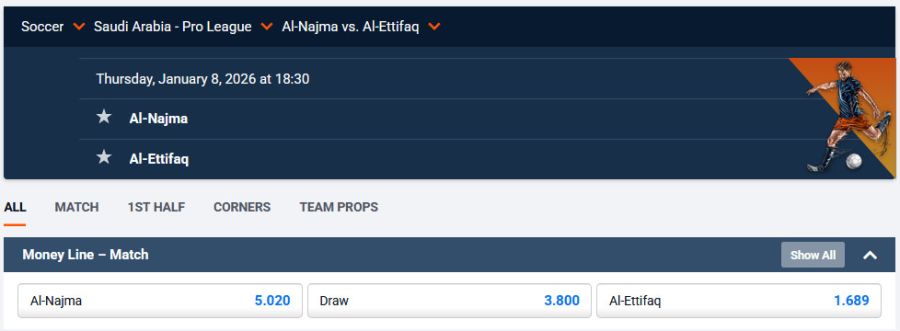
The odds offered by Pinnacle for this match were:
- 1 → 5.020
- X → 3.800
- 2 → 1.689
First, we calculate the bookmaker’s margin:
Margin = ((1/5.020)+(1/3.800)+(1/1.689))×100((1 / 5.020) + (1 / 3.800) + (1 / 1.689)) × 100((1/5.020)+(1/3.800)+(1/1.689))×100 – 100
Margin ≈ 5.42%
We then remove this margin to obtain the “true” market odds:
- 1 → 5.292
- X → 4.006
- 2 → 1.781
Which gives Pinnacle’s implied real probabilities:
- 1 → 1 / 5.292 = 18.90%
- X → 1 / 4.006 = 24.96%
- 2 → 1 / 1.781 = 56.14%
Probability comparison
We now compare our probabilities with the bookmaker’s:
- 1: 15% vs 18.90% → no value
- X: 18% vs 24.96% → no value
- 2: 67% vs 56.14% → strong value
Our estimate produced a fair price of 1.49, while Pinnacle was offering 1.689.
This represents a mathematical edge of:
(1.689 / 1.492) × 100 = 113.20%
👉 Which corresponds to a +13.20% expected value bet.
Result and long-term logic
The match ended with a 4–3 win for Al-Ettifaq.
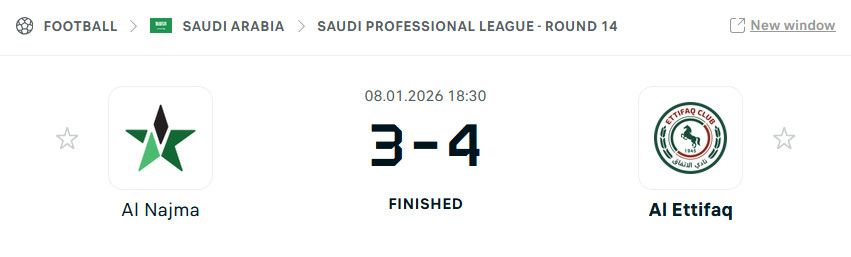
In this specific case, the final result confirmed our position. However, one point is absolutely critical:
✔️ A single match never validates a method.
✔️ Only a large sample size validates a model.
Even with a genuine mathematical edge, many bets will lose. What makes the difference is not the apparent strike rate, but the consistent gap between your probabilities and those of the market.
Over the long term, if your algorithm is accurate and you only bet when value is present, mathematics will do the work.
Conclusion
Being profitable in sports betting is not about instinct, passion for sport, or searching for “sure wins.”
It relies exclusively on three pillars:
- statistical modeling,
- accurate probability estimation,
- systematic identification of value bets.
It is not the easiest approach.
It is not the most exciting.
But it is the only one that works in the long run.
Wednesday, January 14, 2026
In my same category
Education
Risk of Ruin: Can You Really Lose Your Entire Bankroll?
Saturday, September 19, 2026
You have a €5,000 bankroll.You bet €50 per wager, or 1% of your initial capital.Your strategy appears to be profitable over the long term.Can you still lose your entire bankroll?This question brings us to one of the most important concepts in sports betti...
See the articleEducation
Drawdown: How Far Can Your Bankroll Fall?
Wednesday, September 16, 2026
Can a €5,000 bankroll fall to €4,500 even if your strategy is profitable?Yes.Can it fall to €4,000?That is also possible.What about €3,500?For some strategies, this may still be compatible with normal variance.This is precisely why one indicator is essent...
See the articleEducation
Bankroll and Variance: Why a Good Bettor Can Lose for Several Weeks
Monday, September 14, 2026
In sports betting, one of the most common mistakes is assuming that a good bettor should win consistently.A few losing days can feel worrying.Two negative weeks can make you question a strategy.A difficult month can even create the impression that an Edge...
See the articleBet2Invest is not a bookmaker and does not offer sports betting services. However, its content is related to sports betting activities.
Gambling is strictly prohibited for minors. Play responsibly — excessive gambling can lead to financial loss, debt, or addiction.