Introduction
A sports bettor can consistently identify positive expected value bets, regularly obtain better odds than the market's closing prices, and still lose their entire bankroll.
How is that possible?
Because the ability to identify profitable betting opportunities is not enough to guarantee a bettor's financial survival.
Bankroll management is a fundamental component of any professional approach to sports betting.
It determines how much to stake, how to respond to losses, how to manage periods of high variance, and how to preserve capital when results deviate from expectations.
However, certain mistakes can destroy months or even years of accumulated profits.
These mistakes are not limited to beginners.
Experienced bettors can also make irrational decisions, particularly after winning streaks, significant drawdowns, or periods of frustration.
In this article, we will examine ten major bankroll management mistakes.
For each one, we will explore:
- How the mistake occurs.
- Its mathematical consequences.
- A practical example using a $5,000 bankroll.
- A corrective approach to reduce the associated risk.
Our objective is not to promise profits.
It is to understand why certain decisions dramatically increase the risk of ruin, even when a bettor possesses genuine expertise.
1. Staking Too Large a Percentage of Your Bankroll
The first mistake is risking an excessive proportion of your capital on a single bet.
Imagine a bettor with a $5,000 bankroll.
They are considering three different staking levels:
- 1% of the bankroll: $50.
- 5% of the bankroll: $250.
- 10% of the bankroll: $500.
At first glance, larger stakes offer the possibility of higher profits when bets win.
But they also amplify potential losses by exactly the same proportion.
Simulation: Ten Consecutive Losing Bets
Assume the bettor uses fixed stakes calculated from the initial bankroll.
| Stake per Bet | Initial Bankroll Percentage | Loss After 10 Defeats | Remaining Bankroll | Drawdown |
|---|---|---|---|---|
| $50 | 1% | -$500 | $4,500 | -10% |
| $250 | 5% | -$2,500 | $2,500 | -50% |
| $500 | 10% | -$5,000 | $0 | -100% |
With a 1% stake, ten consecutive losses reduce the initial bankroll by 10%.
With a 5% stake, half the capital disappears.
With a 10% stake, the bankroll is completely exhausted.
These results assume fixed stakes. If stakes were recalculated as a percentage of the remaining bankroll after every bet, the outcomes would differ.
Why Are Ten Consecutive Losses Possible?
Even a bettor with positive expected value can experience a long losing streak.
Consider bets with average decimal odds of 2.00 and a true winning probability of 52%.
The probability of losing a single bet is 48%.
Assuming independence, the probability that a specific sequence of ten bets all loses is:
0.48¹⁰ ≈ 0.065%
This may appear extremely unlikely.
However, a bettor placing thousands of bets encounters many possible sequences of ten bets.
The probability of experiencing at least one ten-bet losing streak over an extended period is therefore higher than the probability associated with one predetermined sequence.
How to Avoid This Mistake
A conservative starting rule is to stake 1% of the bankroll per bet.
For a $5,000 bankroll, this means $50.
This rule does not eliminate the possibility of significant losses, but it limits the impact of any individual bet.
The priority is not to maximize the profit from one bet. It is to preserve enough capital to exploit future opportunities.
2. Increasing Stakes to Recover Losses
This mistake is commonly known as chasing losses.
It involves increasing stakes after losing bets in an attempt to recover previous losses as quickly as possible.
It is one of the most dangerous bankroll management behaviors.
Simulation: The Classic Martingale
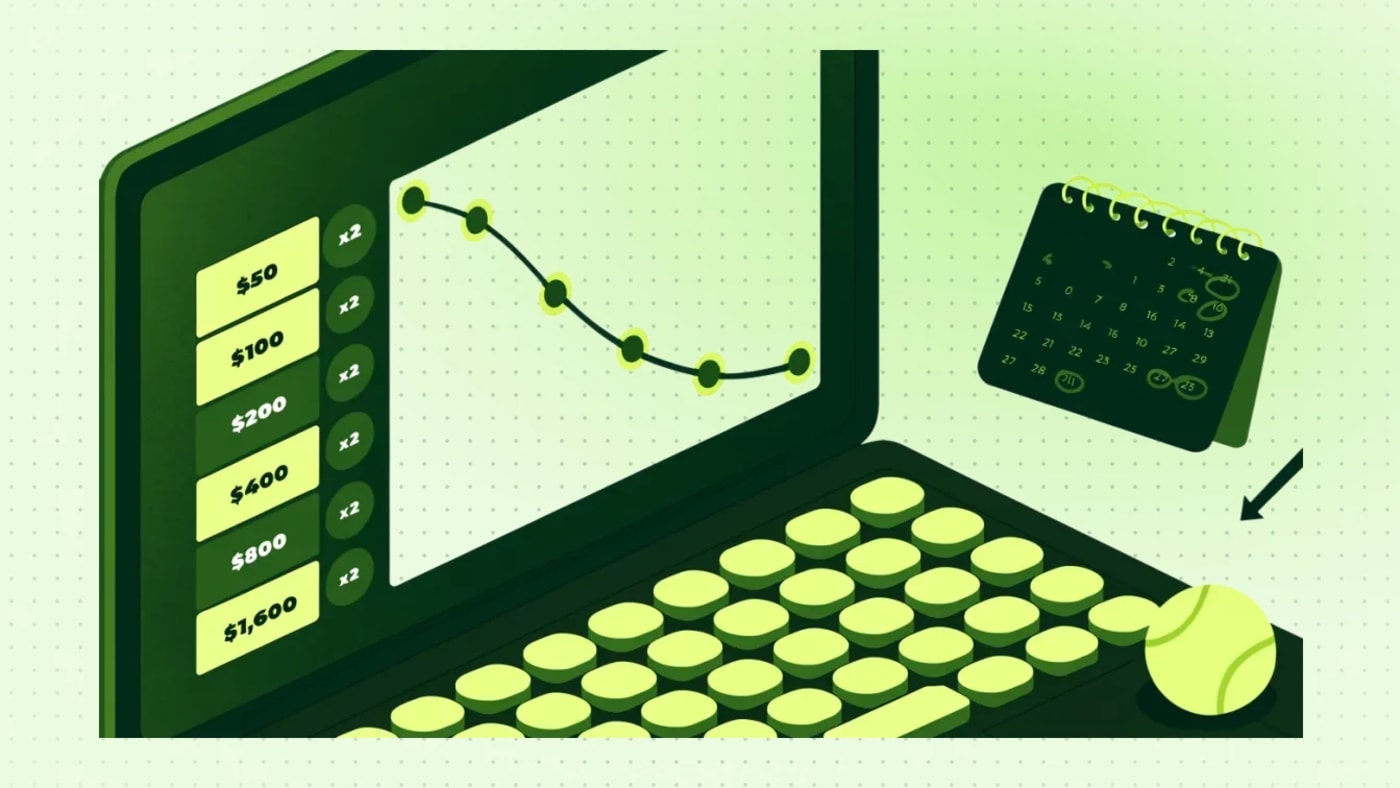
A bettor starts with a $50 stake at decimal odds of 2.00.
After every loss, the stake doubles.
| Bet | Stake | Cumulative Loss if the Bet Loses |
|---|---|---|
| 1 | $50 | -$50 |
| 2 | $100 | -$150 |
| 3 | $200 | -$350 |
| 4 | $400 | -$750 |
| 5 | $800 | -$1,550 |
| 6 | $1,600 | -$3,150 |
| 7 | $3,200 | -$6,350 |
With a $5,000 bankroll, the bettor cannot even fund the seventh stake after six consecutive losses.
Yet the system is designed to recover all previous losses and generate just $50 in profit after a single win, provided the progression can continue and the required odds remain available.
The problem is obvious.
The bettor is exposing thousands of dollars to pursue a profit of only $50.
Why Doesn't the Martingale Create Value?
The Martingale does not change the true probability of winning.
It cannot transform a negative expected value bet into a positive expected value bet.
It only changes the distribution of wins and losses.
The system often produces small gains but exposes the bettor to extremely large losses when an extended losing streak occurs.
Furthermore, bookmaker stake limits and finite bankrolls make unlimited progression impossible.
How to Avoid This Mistake
The stake for the next bet should be determined independently of whether the previous bet won or lost.
A previous loss is not a mathematical reason to increase the next stake.
Losing a bet does not automatically make the next betting opportunity more profitable.
3. Dramatically Increasing Stakes After a Winning Streak
Losses are not the only cause of poor bankroll decisions.
Winning streaks can be equally dangerous.
After several profitable weeks, bettors may believe their strategy has become more effective.
They consequently increase their stakes.
However, a winning streak does not necessarily demonstrate that the strategy's statistical edge has improved.
Simulation: Excessive Stake Increases
A bettor starts with $5,000.
After a successful period, the bankroll reaches $6,000.
The bettor decides to increase the stake from $50 to $300 per bet.
Eight consecutive losses then occur.
| Staking Method | Stake | Loss Over 8 Bets | Remaining Bankroll |
|---|---|---|---|
| Maintain original stake | $50 | -$400 | $5,600 |
| Stake 1% of new bankroll | $60 | -$480 | $5,520 |
| Excessive stake increase | $300 | -$2,400 | $3,600 |
With $300 stakes, the bettor loses 40% of the $6,000 bankroll.
The bankroll falls below its original level.
All accumulated profits disappear, followed by part of the starting capital.
Why Does This Happen?
Human decision-making tends to give disproportionate importance to recent results.
After a winning streak, bettors may overestimate their abilities or the reliability of their strategy.
This behavior is associated with overconfidence bias.
How to Avoid This Mistake
Stake increases should follow predefined rules.
For example, bankroll size and strategy quality can be reassessed periodically.
Another approach is to maintain fixed stakes throughout a predetermined period.
Stakes should evolve according to a bankroll management plan, not according to the excitement generated by recent wins.
4. Confusing Positive ROI With Bankroll Growth
A positive ROI is an important performance indicator.
However, it does not automatically mean that sports betting activity is profitable after all expenses.
A bettor can achieve a +3% ROI and still lose money once operating costs are deducted.
Simulation: Positive ROI, Negative Net Result
Consider a $5,000 bankroll.
The bettor places 1,000 bets of $50 each.
Total stakes amount to $50,000.
With a +3% ROI, gross betting profit is:
$50,000 × 3% = $1,500
Now assume the bettor pays $150 per month for subscriptions, tools, and services.
Annual expenses total $1,800.
| Indicator | Amount |
|---|---|
| Initial bankroll | $5,000 |
| Number of bets | 1,000 |
| Average stake | $50 |
| Total stakes | $50,000 |
| ROI | +3% |
| Gross profit | +$1,500 |
| Annual expenses | -$1,800 |
| Net result | -$300 |
| Final bankroll | $4,700 |
The bettor has a positive ROI, but the bankroll declines by 6%.
Calculating the Break-Even ROI
The minimum ROI required to cover $1,800 in expenses on $50,000 in stakes is:
$1,800 ÷ $50,000 × 100 = 3.6%
The bettor therefore needs an ROI above 3.6% to generate a net profit in this example.
How to Avoid This Mistake
Track the following separately:
- Betting ROI.
- Gross betting profit.
- Operating expenses.
- Net profit.
- Actual bankroll evolution.
Costs must be included before concluding that a strategy is economically profitable.
5. Ignoring Maximum Drawdown
A strategy may show a +5% ROI over several thousand bets while having experienced substantial losing periods.
Ignoring those periods means underestimating the risks involved.
Simulation: A Bankroll Losing 40%
A bettor has $5,000.
A prolonged losing period reduces the bankroll to $3,000.
The loss is $2,000, or 40%.
To recover the original $5,000, the bettor must now generate $2,000 in profit from a remaining bankroll of $3,000.
The required return is:
$2,000 ÷ $3,000 × 100 = 66.67%
| Bankroll Loss | Remaining Capital From $5,000 | Return Required to Recover |
|---|---|---|
| -10% | $4,500 | +11.11% |
| -20% | $4,000 | +25% |
| -30% | $3,500 | +42.86% |
| -40% | $3,000 | +66.67% |
| -50% | $2,500 | +100% |
| -60% | $2,000 | +150% |
| -80% | $1,000 | +400% |
The greater the loss, the higher the percentage return required to recover the original bankroll.
This relationship is not linear.
Why Is Maximum Drawdown Essential?
Maximum Drawdown helps bettors understand the historical losses they would have needed to tolerate to achieve the reported results.
However, its limitations must also be understood.
Historical Maximum Drawdown is not a maximum limit on future losses.
A strategy that previously experienced a 20U drawdown could suffer a 30U drawdown or worse in the future.
How to Avoid This Mistake
Before following a tipster or strategy, analyze its ROI, CLV, number of bets, and Maximum Drawdown.
Also verify that the chosen stake size allows the bankroll to withstand unfavorable periods without putting the entire capital at risk.
6. Following Multiple Strategies That Take the Same Risks
A bettor may believe their bankroll is diversified because they follow four different tipsters.
However, if those experts regularly bet on the same teams, competitions, and markets, the diversification may be largely an illusion.
Simulation: Four Strategies Betting on One Event
A bettor follows four strategies.
Each recommends a $50 stake.
| Situation | Number of Bets | Total Stakes | Main Risk |
|---|---|---|---|
| Four separate events | 4 | $200 | Distributed across different outcomes |
| Same event, same selection | 4 | $200 | Concentrated on one outcome |
In both cases, $200 is at risk.
But the risk profiles are different.
If all four bets concern the same outcome and that outcome loses, the entire $200 is lost simultaneously.
If the bets concern different events, their outcomes may differ, although independence is not guaranteed.
Correlation Is Not Always Obvious
Two strategies can be correlated without placing identical bets.
For example:
- One strategy backs a team to win.
- Another backs the same team on the Asian handicap.
- A third bets on that team's goals.
All three bets may depend heavily on the same match scenario.
How to Avoid This Mistake
Analyze correlations between strategies and monitor exposure by event.
It may also help to diversify sports, betting markets, leagues, and analytical methods.
True diversification means spreading risks, not simply multiplying subscriptions.
7. Failing to Control Simultaneously Open Bets
Even with a conservative 1% stake, a bettor can accumulate excessive exposure by placing too many bets simultaneously.
Simulation: 30 Open Bets
A bettor has a $5,000 bankroll.
The standard stake is $50.
On a Saturday, several strategies publish selections.
The bettor places 30 bets before any of them are settled.
Total exposure is:
30 × $50 = $1,500
This represents 30% of the initial bankroll.
| Number of Open Bets | Stake per Bet | Total Exposure | Percentage of Bankroll |
|---|---|---|---|
| 5 | $50 | $250 | 5% |
| 10 | $50 | $500 | 10% |
| 15 | $50 | $750 | 15% |
| 20 | $50 | $1,000 | 20% |
| 30 | $50 | $1,500 | 30% |
Each individual stake remains at 1%.
But total exposure reaches 30%.
In theory, every open bet could lose.
How to Avoid This Mistake
Define a maximum simultaneous exposure limit.
For example, a conservative framework might restrict unsettled stakes to 10% of the bankroll.
For $5,000, this would mean $500.
This is an illustrative rule, not a universally optimal threshold.
It should be adjusted according to the strategies, their correlations, and the characteristics of the markets involved.
8. Ignoring CLV and the Actual Odds Obtained
A strategy can display an excellent historical ROI without that performance being reproducible.
One major reason is the difference between the odds used in historical records and the odds actually obtained by followers.
Simulation: A Small Odds Difference That Destroys Value
Assume a selection has an estimated true winning probability of 52%.
At decimal odds of 2.00, its expected ROI is:
(0.52 × 2.00) - 1 = +4%
But if the bettor only obtains odds of 1.90:
(0.52 × 1.90) - 1 = -1.2%
| Odds Obtained | Assumed True Probability | Expected ROI |
|---|---|---|
| 2.00 | 52% | +4.00% |
| 1.98 | 52% | +2.96% |
| 1.95 | 52% | +1.40% |
| 1.92 | 52% | -0.16% |
| 1.90 | 52% | -1.20% |
A relatively small reduction in odds can turn a positive expected value bet into a negative expected value bet.
Consequences Over 1,000 Bets
Assume 1,000 bets of $50 each.
Total stakes are $50,000.
With an expected ROI of +4%, theoretical expected profit is $2,000.
With an expected ROI of -1.2%, theoretical expected loss is $600.
The difference is $2,600.
These calculations assume a constant true winning probability of 52% and are intended solely to illustrate the impact of odds.
How to Avoid This Mistake
Track the odds actually obtained and compare them with reference odds.
CLV is particularly useful for evaluating the quality of the prices secured.
However, positive CLV does not guarantee that every bet has positive expected value.
It must be interpreted alongside ROI, bookmaker margins, betting volumes, and data quality.
Autobetting can reduce certain execution delays, but it cannot guarantee that the published odds will remain available.
9. Ignoring Betting Limits and Market Liquidity
A bettor may identify a strategy with an outstanding historical record.
But if the market does not allow the intended stake, theoretical performance becomes difficult to reproduce.
Simulation: Planning to Stake $50 but Executing Only $20
A bettor plans to place 1,000 bets of $50 each with a hypothetical +5% ROI.
The planned total stakes are $50,000.
Theoretical expected profit is:
$50,000 × 5% = $2,500
Now suppose market conditions only allow an average stake of $20 per bet.
Total stakes fall to $20,000.
Assuming the same ROI, expected profit becomes:
$20,000 × 5% = $1,000
| Indicator | Planned Scenario | Actual Execution Scenario |
|---|---|---|
| Number of bets | 1,000 | 1,000 |
| Average stake | $50 | $20 |
| Total stakes | $50,000 | $20,000 |
| Hypothetical ROI | +5% | +5% |
| Theoretical profit | $2,500 | $1,000 |
The ROI remains unchanged, but expected profit falls by 60%.
If subscription costs remain unchanged, net profitability may deteriorate substantially.
The Role of AVG BM
On Bet2invest, AVG BM (Avg max bet) represents the average maximum stake permitted by Pinnacle at the time each tipster selection is published.
This metric helps assess the liquidity of the markets used by a tipster.
However, it does not guarantee that all subscribers can simultaneously place the same stakes at the same odds.
How to Avoid This Mistake
Before following a strategy, verify that the relevant markets are compatible with the intended stake size.
Also monitor actual execution rates, odds movements, and applicable betting limits.
A theoretically profitable strategy is useful only if it can be executed under conditions sufficiently close to those used to evaluate its historical performance.
10. Constantly Changing Strategies Based on Recent Results
The final mistake is particularly common.
A bettor chooses a strategy after an excellent period.
A few weeks later, results turn negative.
The bettor abandons that strategy and switches to another one that has just experienced a winning streak.
Then the process repeats.
This approach means continually selecting strategies based on their most recent results.
Simulation: Chasing Past Performance
Consider two strategies, A and B.
The bettor starts with a $5,000 bankroll.
Each quarter, the bettor chooses the strategy that performed best in the previous quarter.
Here is a fictional example.
| Quarter | Strategy A | Strategy B | Strategy Followed | Result Obtained |
|---|---|---|---|---|
| Q1 | +$400 | -$200 | A | +$400 |
| Q2 | -$300 | +$350 | A | -$300 |
| Q3 | +$250 | -$250 | B | -$250 |
| Q4 | -$200 | +$300 | A | -$200 |
| Total | +$150 | +$200 | -$350 |
In this example, both strategies finish the year with positive results.
Yet the bettor who continually switches strategies loses $350.
Why?
Because the bettor selects strategies after their strong performance, without any guarantee that those results will continue.
The Problem of Recency Bias
Recent results naturally attract attention.
However, a few weeks of profits or losses may not provide enough evidence to determine whether a strategy has genuine positive expected value.
The number of bets, variance, CLV, and stability of market conditions must also be considered.
How to Avoid This Mistake
Establish an evaluation process before starting.
For example:
- Review results at predefined intervals.
- Compare ROI and CLV.
- Analyze drawdowns.
- Check for changes in the underlying methodology.
- Evaluate actual execution conditions.
- Avoid switching strategies based solely on a handful of recent results.
This does not mean keeping an underperforming strategy forever.
It means making decisions using consistent criteria rather than emotional reactions.
11. Summary Table: The 10 Mistakes and Their Consequences
We have examined ten mistakes that can seriously undermine bankroll management.
| Mistake | Main Risk | Illustrated Consequence |
|---|---|---|
| 1. Staking too much | Excessive exposure | Ten losses at 10% exhaust $5,000 |
| 2. Chasing losses | Uncontrolled stake progression | Six Martingale losses cost $3,150 |
| 3. Overstaking after wins | Overconfidence | Eight $300 losses cost $2,400 |
| 4. Confusing ROI and net profit | Underestimated expenses | +3% ROI, -$300 net result |
| 5. Ignoring drawdown | Underestimating risk | A 40% loss requires +66.67% to recover |
| 6. Poor diversification | Correlated risks | $200 concentrated on one outcome |
| 7. Too many open bets | Cumulative exposure | Thirty $50 bets expose $1,500 |
| 8. Ignoring actual odds | Loss of expected value | EV changes from +4% to -1.2% |
| 9. Ignoring liquidity | Unreproducible profits | Theoretical profit falls from $2,500 to $1,000 |
| 10. Constantly switching | Decisions based on recent results | -$350 despite two profitable strategies |
These ten mistakes share one important characteristic.
They can damage a bettor's results independently of their ability to identify valuable betting opportunities.
12. How to Build a Disciplined Bankroll Management Framework
Avoiding the mistakes discussed above requires rules established in advance.
With a $5,000 starting bankroll, a management framework could look like this.
| Parameter | Example Rule |
|---|---|
| Initial bankroll | $5,000 |
| Standard stake | 1% |
| Initial stake per bet | $50 |
| Increase after a loss | No automatic increase |
| Stake progression | Based on planned rebalancing |
| Simultaneous exposure | Illustrative 10% limit |
| Performance monitoring | ROI, CLV, net profit |
| Risk monitoring | Maximum Drawdown, correlations |
| Execution monitoring | Obtained odds, AVG BM, execution rate |
| Reassessment | At predefined intervals |
| Reinvestment | According to an established rule |
This framework is intentionally simple.
It is not a universally optimized mathematical model.
Every bettor should adapt the parameters to the volatility of the strategies followed, their financial circumstances, and their risk tolerance.
The essential point is to establish consistent rules before placing bets.
13. The Role of Bet2invest in Disciplined Bankroll Management
Bet2invest provides several tools for analyzing sports betting strategies and their execution conditions.
Certified Performance Records
Tipster histories are associated with Pinnacle odds, including opening and closing prices.
This provides verifiable data rather than relying solely on self-reported performance claims.
ROI and CLV Monitoring
These indicators help evaluate historical profitability and the quality of the odds obtained.
AVG BM (Avg max bet)
This metric measures the average maximum stake permitted by Pinnacle when a tipster's selections were published.
Autobetting
Autobetting enables compatible selections to be followed automatically, subject to the applicable execution conditions.
Strategy Builder
Strategy Builder allows users to analyze strategies using historical Pinnacle odds data, covering ten years for football and five years for other sports.
Users can either follow existing strategies or create their own using statistical filters.
However, no tool can guarantee profitability.
Responsible capital management and ongoing risk assessment remain essential.
Conclusion: A Bettor's First Responsibility Is to Preserve Their Bankroll
A bettor may possess extensive sports knowledge, understand probabilities, and identify positive expected value opportunities.
But these skills are not enough when bankroll management is inadequate.
The ten mistakes examined in this article demonstrate how a few poorly controlled decisions can undermine years of work.
Staking too much.
Chasing losses.
Increasing stakes dramatically after winning streaks.
Ignoring costs.
Underestimating drawdowns.
Diversifying poorly.
Accumulating too many open bets.
Accepting deteriorated odds.
Ignoring market limits.
Constantly switching strategies.
These mistakes have different consequences, but they can all lead to the same outcome: substantial capital losses or even complete bankroll depletion.
Long-term profitability depends on the quality of betting decisions, execution conditions, and disciplined capital management.
With a $5,000 bankroll, a standard 1% stake represents $50.
This rule does not guarantee profits.
It does not eliminate variance, drawdowns, or the risk of ruin.
But it provides a reasonable starting point for developing a more structured approach.
The objective is not to win as much as possible on the next bet.
It is to remain capable of making rational decisions after a losing streak without having compromised the entire bankroll.
In the next and final article of this series, we will bring together the key lessons to build a complete bankroll management plan, including operational rules, monitoring indicators, and a systematic reassessment process.
FAQ: Bankroll Management Mistakes in Sports Betting
1. What is the most dangerous bankroll management mistake?
Staking an excessive proportion of your capital is one of the most dangerous mistakes because it can lead to rapid and irreversible bankroll losses. Increasing stakes to recover previous losses can amplify this risk.
2. Is staking 1% of your bankroll per bet reasonable?
A 1% stake is a conservative reference point in many bankroll management approaches. However, it does not guarantee profitability and should be adapted to strategy volatility, correlations, and overall risk.
3. Can a profitable strategy lose ten bets in a row?
Yes. A positive expected value strategy can experience substantial losing streaks. Their probability depends on the win rate, odds, and dependence between outcomes.
4. Why is the Martingale dangerous?
Because it requires stakes to increase rapidly after each loss. With a limited bankroll, an extended losing streak can make the system impossible to continue and cause substantial losses.
5. Should stakes be increased after several wins?
Not automatically. A winning streak does not prove that a strategy's quality has improved. Any increase should follow a predefined bankroll management rule and a reassessment of risk.
6. Can you have a positive ROI and still lose money?
Yes. If subscription fees, tools, and execution costs exceed betting profits, the net result can be negative despite a positive ROI.
7. Why is a 50% bankroll loss particularly difficult to recover?
Because a bankroll reduced by half must subsequently increase by 100% to return to its original value. The larger the drawdown, the greater the percentage return required for recovery.
8. Does following multiple tipsters automatically reduce risk?
- Different tipsters may select the same events or use similar methods. Correlations and shared risks must be analyzed.
9. How many bets can be open simultaneously?
There is no universal number. The appropriate level depends on stake sizes, bankroll, correlations, and markets. Defining a maximum total exposure is generally more useful than setting a simple maximum number of bets.
10. Why is CLV important?
CLV compares the odds obtained with market closing odds. It provides information about price quality but does not guarantee profitability on its own.
11. Can a profitable strategy become unprofitable because of the odds?
Yes. Lower odds can reduce or eliminate a bet's positive expected value. It is essential to compare the odds actually obtained with those used to evaluate the strategy.
12. What is AVG BM on Bet2invest?
AVG BM (Avg max bet) represents the average maximum stake permitted by Pinnacle when a tipster's selections were published. It helps assess market liquidity but does not guarantee identical execution conditions for every subscriber.
13. Should a strategy be abandoned after a major drawdown?
Not necessarily. It is important to determine whether the drawdown is a plausible fluctuation or whether there are signs that the statistical edge has deteriorated. ROI, CLV, execution conditions, and methodology should be reassessed.
14. How often should bankroll management be reviewed?
Key indicators can be monitored monthly, with a more comprehensive evaluation at regular intervals, such as every three or six months. The appropriate frequency depends on betting activity and volume.
15. What is the fundamental rule for avoiding bankroll ruin?
Never risk a proportion of capital that is incompatible with your ability to withstand losses, and do not change stakes solely in response to recent results. Disciplined bankroll management cannot guarantee profits, but it can help reduce avoidable mistakes.